 The Prep Bible.
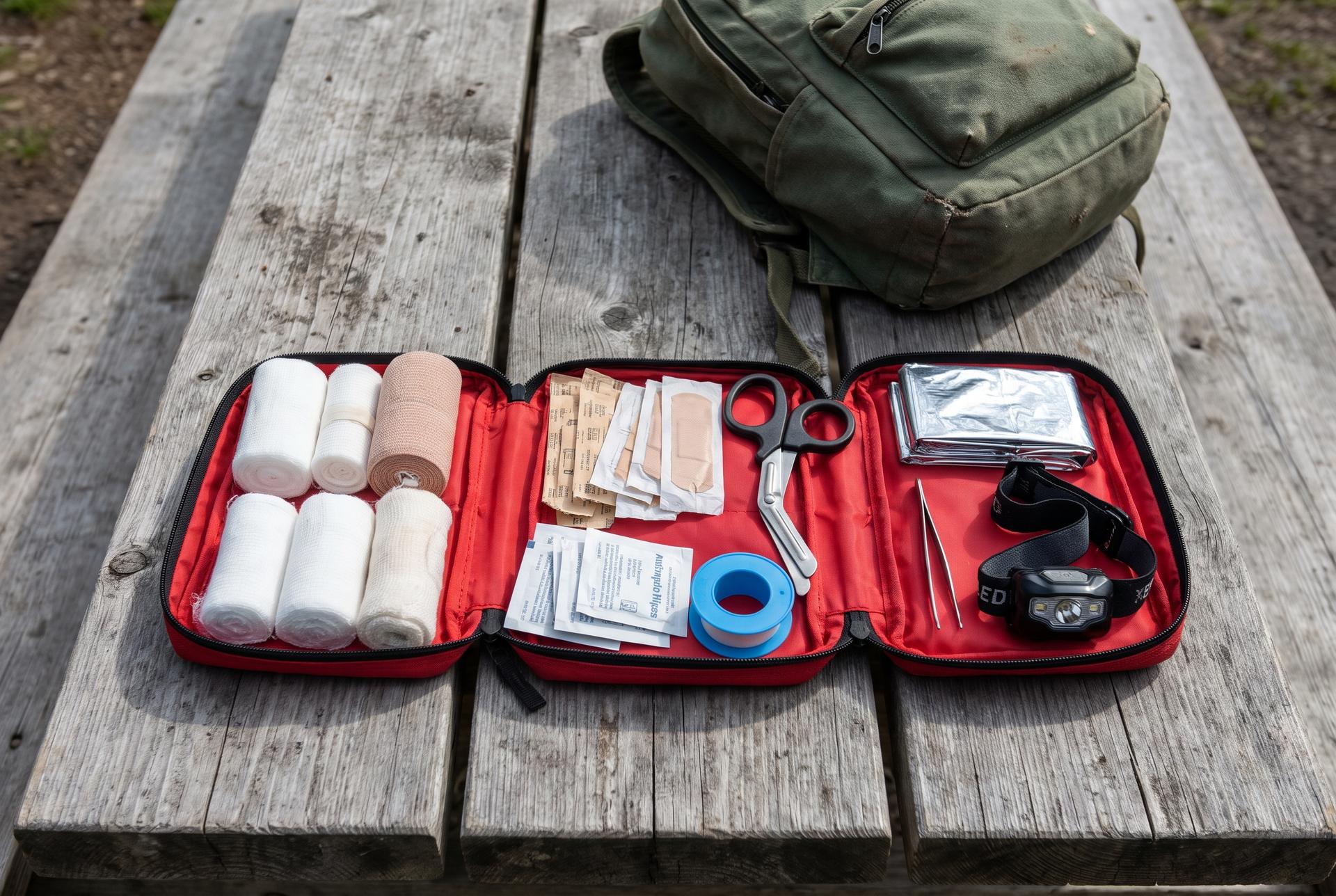
Camping First Aid Kit Checklist: What to Pack and How to Choose
A camping first aid kit covers the small, likely injuries first: cuts, scrapes, blisters, splinters, burns, bites, sprains and upset stomachs. Build around those, add the few things that matter when help is far away, then pack it so you can find any item in the dark without emptying the bag.
The checklist below is the one most campsite kits are built from. It is not a legal standard and it is not a trauma kit. Read it as a starting list, then scale it to how long you will be out, how many people are with you and how long it would take to reach a road or a clinic.
The rest of the guide covers how to decide between a pre-made kit and a pouch you fill yourself, how to carry it so it gets used, and the maintenance that keeps it from turning into a bag of crumbling tape and dead batteries.
What a Camping First Aid Kit Needs to Cover
Camp injuries are boring and repetitive. Knife nicks while prepping food, blisters from new boots, burns from a pot handle or a fire lay, a rolled ankle on a root, insect bites, sunburn, a splinter, a headache from dehydration. A kit that handles those well will earn its weight every trip.
The second job is buying time. If someone is hurt badly enough that the trip ends, your kit should let you control bleeding, cover a wound, support a joint and keep the person warm while you organise a walk-out or a call for help. That is a short list of items, and it is the part people skip.
The third job is the part no product can do. A kit is only as good as the person opening it. A general first aid course from a recognised provider, ideally one with a wilderness or remote component, changes what every item in the bag is worth. Book the course before you upgrade the pouch.
The Core Checklist: Items Most Campsite Kits Share
Work through this in groups. Grouping is how you remember what is missing, and it is also how you should pack the kit so each category lives in its own compartment or coloured bag.
Wound care: adhesive bandages in a few sizes, sterile gauze pads, a roll of conforming gauze, non-adherent dressings, adhesive tape, wound closure strips, antiseptic wipes, saline or clean water for irrigation, and a pair or two of non-latex gloves.
Bleeding and trauma: a trauma dressing or compressed gauze, and, if you carry one, a commercial tourniquet you have been trained to apply. A tourniquet is not a substitute for training, and an improvised one rarely works as intended.
Blisters and skin: blister dressings or hydrocolloid pads, moleskin, elastic adhesive tape for hot spots, and a small roll of athletic tape. Blisters are among the most common complaints on camping and hiking trips.
Sprains and support: an elastic bandage, a triangular bandage or two for slings and padding, and a roll of self-adhering wrap.
Tools: blunt-tip shears, fine-point tweezers for splinters and ticks, a tick removal tool, safety pins, a small notepad and pencil, and a thermometer if you have room.
Medication and personal items: whatever over-the-counter and prescription medicines each person in the group normally takes, in their own labelled packaging, plus any personal emergency medication such as an inhaler or epinephrine auto-injector. Those are prescription items that belong to one named person, carried by them and used only according to their own prescription and emergency plan. Do not dose other people from your kit, and do not repackage prescriptions into unmarked bags.
Environmental and comfort: sunscreen, lip balm, insect repellent, after-bite treatment, a space blanket or bivvy, oral rehydration sachets and hand sanitiser.
Light and information: a small headlamp or backlight dedicated to the kit, a printed card with group medical details and emergency contacts, and a basic first aid reference booklet. Phone screens die at the worst time.
Scaling the Kit to Trip Length and Group Size
Three things drive kit size: how many people, how many days, and how far you are from help. Treat them as separate dials rather than buying one bigger kit and hoping.
Group size mostly multiplies consumables. Bandages, gauze, wipes, gloves and blister dressings run out. Hardware like shears, tweezers and an elastic bandage does not need duplicating for a weekend group, though a second pair of gloves per adult is sensible.
Trip length drives medication quantity and the depth of your blister and wound supplies. A long trip also means wounds need dressing changes, so carry spare dressings and tape rather than a single application of each.
Distance from help is the one that changes the contents, not just the count. If a road or a trailhead is close by, you can be modest. If an evacuation means hours of walking or waiting, add a bleeding control item, better splinting and padding materials, a reliable light, a warm layer or bivvy and a way to call for help.
Many groups carry two kits. A small personal pouch on each person for blisters, cuts and their own medication, plus a larger group kit at camp or in the vehicle that holds the bulk supplies.
| Dial | What it changes | Practical move |
|---|---|---|
| More people | Consumables run out faster | Multiply bandages, gauze, wipes and gloves, not tools |
| Longer trip | Dressing changes and medication quantity | Carry spares of tape, gauze and dressings |
| Further from help | What the kit must do, not just how much | Add bleeding control, splinting, light and a warm layer |
| Kids in the group | More minor injuries, smaller doses | More plasters, child-appropriate personal medication kept by the parent |
A planning framework, not a standard. Quantities depend on your group, your route and your training.
Pre-Made Kit or Build Your Own
A pre-made kit is the faster start and it is usually the right answer for a first camping kit. The contents are already grouped, the case is sized for them, and you get a count of items instead of a shopping list you half finish. The common failure is that nobody opens it until the day it is needed.
Buying one does not end the job. Open it at home, lay the contents on a table and handle every item. Pull out what you will never use, add your group's personal medication, upgrade the shears and tweezers if they flex or slip, and write the contents on a card that lives inside the lid.
Building your own makes sense when you already know what you use. You get exactly the brands and sizes you like, you can choose the pouch, and resupply is simple because you know the source of everything. It costs more per item and it takes an evening to assemble, and it is easy to end up with four kinds of plaster and no gloves.
A middle route works well: buy a pre-made kit as the base, then move the contents into a pouch you prefer and add the items you know you reach for. You keep the sensible contents list and lose the awkward case.
Pouches, Cases and Carry: Keeping the Kit Findable
The kit you can open one-handed at night is the one that works. Look for a case that opens flat, holds its contents in place when inverted, and uses either clear panels or separate coloured inner bags so you are reading, not rummaging.
Weather resistance matters more at a campsite than people expect. Gauze and tape that have been damp in a pack pocket are not much use. A sealed or welded pouch, or a dry bag liner inside a soft case, keeps the contents usable. A rigid organiser box suits a vehicle or basecamp kit where crush protection is the bigger concern.
Mark it. Bright tape, a first aid label or simply the only red bag in camp means anyone can find it when you are the one who is hurt. Tell the whole group where it lives on day one and do not move it.
Mounting the kit is half the battle. Webbing straps, a belt loop or MOLLE attachment keeps a personal pouch on the outside of a pack where it is reachable. A larger group kit can hang from a tent guyline hook or live in the same place in the vehicle every trip.
Pair the kit with a dedicated light. A headlamp stored with the kit, or clipped to its strap, means both hands stay free. Keep its batteries fresh and check it when you check the kit.
Car Camping, Backpacking and Basecamp Kits
Car camping lets you be generous. Weight and bulk barely matter, so use a rigid organiser or a larger soft case, carry full-size bottles of saline and antiseptic, add a proper pair of shears, a cold pack, a more complete splinting setup and a spare light. Keep it in the vehicle so it is there for the drive as well as the camp.
Backpacking is the opposite problem. Every item has to justify its weight, so favour multi-use: a triangular bandage that becomes a sling, padding or a tie; elastic wrap that supports a joint or holds a dressing; tape that fixes both blisters and gear. Repackage bulk items into small quantities and keep the pouch in a lid pocket or hip belt, not buried in the bottom of the pack.
Basecamp splits the difference. The large kit stays at camp and the day-trip pouch goes out with whoever leaves. Restock the small pouch from the large one each evening, which is also how you notice what you actually used.
Whichever setup you run, the kit should not be the only place your group's safety lives. Water treatment, a reliable light, a warm layer and a way to call for help do more for a bad day than extra plasters.
Storage, Restocking and Expiry Checks
Kits fail quietly. Tape loses its grip, adhesive bandages yellow and peel, antiseptic wipes dry out in their foil, elastic wraps lose their stretch and sterile packaging opens at a corner. None of that announces itself until you need the item.
Set a schedule rather than relying on memory. Check the kit at the start and end of each camping season, and restock immediately after any trip where you used something. Writing the date you packed it on the contents card inside the lid makes that easy.
Check expiry dates on medication, wipes and sterile dressings, and replace anything past date or any package that has lost its seal. Dispose of old medication through a pharmacy take-back where one is available rather than leaving it in the bag.
Storage conditions matter too. Heat cycles in a vehicle over a summer are hard on medication and adhesives, so a vehicle kit needs checking more often than one kept indoors. Batteries in a stored light should be checked at the same time, or removed and taped to the body of the light if it will sit unused for months.
Training That Makes the Kit Worth Carrying
Gear is the easy half. A general first aid course from a recognised provider teaches you what to do before you open the bag, and that sequence is what turns a pile of dressings into useful care. If you camp far from roads, look for a course with a wilderness or remote first aid component, because the assumptions change when help is hours away rather than minutes.
Practise on your own kit. Open the pouch blindfolded and find the gauze. Put the elastic wrap on someone's ankle. Fold a triangular bandage into a sling. Five minutes of this at home is worth more than another item in the bag.
Keep your scope honest. This guide, and any kit, stops at general preparedness: carrying sensible supplies, keeping them in date and knowing where they are. Diagnosis, medication dosing and treatment beyond a basic course belong to trained people, and in an emergency the right move is to get help on the way early.
If you also carry a trauma-focused pouch for range days or vehicle travel, keep it separate from the camping kit rather than merging the two. The contents, the carry position and the training behind them are different.
Pouches, cases and organisers
Weather-resistant bags and compartment boxes that keep kit contents dry, sorted and findable.
Camp tools and field gear
Utensils, cutting tools and small gear that live alongside the kit in a camp box.
Common questions
- What should be in a camping first aid kit?
- Wound care such as adhesive bandages, gauze, tape, wound closure strips, antiseptic wipes and gloves. Blister dressings and moleskin. An elastic bandage and triangular bandages for sprains and slings. Blunt-tip shears, tweezers and a tick tool. Each person's own labelled medication. Sunscreen, insect repellent, rehydration sachets, a space blanket and a small light stored with the kit.
- Is a pre-made camping first aid kit good enough?
- Usually yes, as a starting point. A pre-made kit gives you grouped contents and a case sized for them, which beats a half-finished shopping list. Open it at home, handle every item, add your group's personal medication, upgrade the shears and tweezers if they feel flimsy, and write the contents and the pack date on a card inside the lid.
- How big should the kit be for a weekend with four people?
- A soft pouch or small case is enough for a weekend, with consumables multiplied rather than tools. Carry extra adhesive bandages, gauze, wipes and a pair of gloves per adult, plus blister dressings for everyone. Keep one set of shears, tweezers and an elastic bandage. If help is a long way off, add bleeding control and a warm layer.
- What is the difference between a camping first aid kit and an IFAK?
- A camping kit is built for the common, minor injuries of outdoor living: cuts, blisters, burns, bites, sprains and stomach upsets. An IFAK is a trauma-focused pouch built around serious bleeding and airway problems, carried differently and used under different training. They solve different problems, so keep them as separate kits rather than merging the contents.
- How often should I check and restock the kit?
- Check it at the start and end of each camping season, and restock straight after any trip where you used something. Look at expiry dates on medication, wipes and sterile dressings, and replace anything past date or any packet that has lost its seal. A kit stored in a vehicle sees heat cycling and needs checking more often than one kept indoors.
- Where should the first aid kit live at camp?
- In one agreed place that everyone knows on day one, and not moved afterwards. On the outside of a pack, on a belt or clipped to webbing when you are moving. At camp, hang it on a guyline hook or keep it in the same spot in the vehicle. Mark it clearly so anyone can find it when you are the one who is hurt.