 The Prep Bible.
MOLLE System Explained: How PALS Webbing Works and How to Set It Up
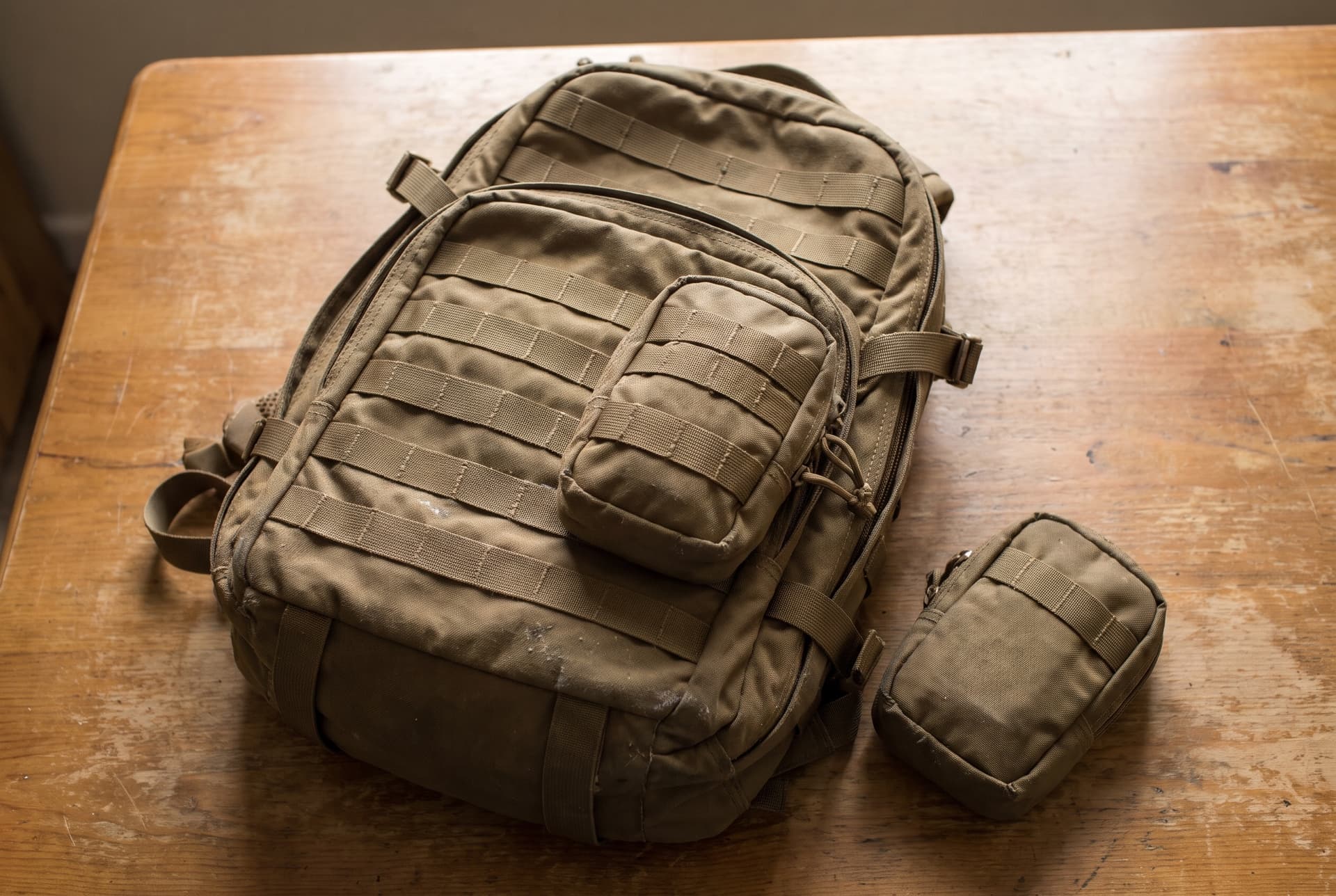
MOLLE is the attachment system; PALS is the grid of webbing it attaches to. The rows of nylon loops stitched across a pack, belt or carrier let you add, move or remove pouches without tools, and a pouch is attached correctly when its straps weave alternately through a row on the pouch, then a row on the host panel, all the way down, and finish snapped or tucked.
Most problems people have with MOLLE come from skipping that alternating weave. A pouch threaded straight through the host webbing and snapped shut will hold for a while, then work loose, rock away from the panel and bounce. Weave it properly and it sits like it was sewn there.
This guide covers what the two terms actually mean, how the grid is spaced, the weaving method step by step, how to plan a loadout on a pack, belt or chest rig, and how MOLLE compares with the other attachment systems you will meet on modern gear.
What MOLLE and PALS actually mean
MOLLE stands for Modular Lightweight Load-carrying Equipment. It is a United States military load carriage system, and the name covers the whole family of packs, vests and pouches that work together.
PALS, Pouch Attachment Ladder System, is the part most people are pointing at when they say MOLLE. It is the ladder of horizontal nylon webbing rows stitched to the outside of a pack, carrier or belt in rows. Each row is tacked down at intervals, which creates a grid of loops.
So a pack is not "MOLLE compatible" because it has webbing. It is compatible because that webbing is laid out on the standard grid, so a pouch built to the same grid will line up and weave through it. In everyday use the two words have merged, and sellers list PALS panels as MOLLE. That is fine, as long as you know what you are checking: whether the pouch rows and straps line up with the rows and stitch lines on the panel.
The payoff is modularity. One pack can be a day pack with nothing on it, a kit-heavy overnight pack with pouches down both sides, or a base for a dedicated medical rig, and you change it on the kitchen table in the time it takes to unweave and re-weave the pouches involved.
How PALS webbing is measured, and how to count it
You do not need a tape measure to shop for pouches, you need to be able to count. Pouch listings describe size in columns and rows: a two by three pouch covers two columns of webbing across and spans three rows down. Hold the pouch against the panel and the match is obvious within seconds.
To count columns, look at the vertical stitch lines that tack the webbing down. The gap between two stitch lines is one column, one loop, one place a strap passes through. To count rows, count the horizontal strips of webbing the pouch will cross, including the one its lowest strap finishes in.
Two things are worth checking before you buy. First, does the panel have enough clear rows below your intended position for the pouch to finish its weave? A pouch that runs out of webbing partway down cannot be secured properly. Second, is the panel backed by anything stiff? A loose, unsupported panel on a soft pack will let a heavy pouch flop regardless of how well it is woven.
Laser-cut panels are the modern variant. Instead of stitched webbing, slots are cut into a laminate sheet in the same grid pattern. Pouch straps weave through the slots the same way, and the panel is thinner and lighter. The weaving method below applies to both.
How to attach a MOLLE pouch the right way
The straps on the back of the pouch must alternate: through a pouch row, then through a host row, then back through the pouch, then the host, down to the end. That alternation is what locks the pouch flat. Threading everything through the host webbing in one pass and snapping it leaves the pouch hinged at the top and free to swing.
Work on a table with the panel facing up, not on your back and not with the pack loaded. Start the straps high and weave downward, keeping the pouch square to the panel as you go. The first two passes set the alignment for everything after them.
Pull each pass snug before starting the next. A loose pass eats length, and you will run out of strap before the bottom. If the strap ends up too short to snap, you have almost always missed an alternation or left slack higher up.
Finish by closing the snap, tab or hook-and-loop tab at the bottom, then tug the pouch hard in four directions. Up, down, and both sides. A correctly woven pouch moves with the panel, not against it.
| Step | What to do | What it should look like |
|---|---|---|
| 1 | Lay the host panel flat and hold the pouch where you want it | Pouch square, top edge level with a webbing row |
| 2 | Pass the first strap through the top host row, behind the webbing | Strap emerges below the host row |
| 3 | Pass it through the pouch's own next row of webbing | Strap now in front of the host panel |
| 4 | Pass it back through the next host row down | Alternating in-out pattern forming |
| 5 | Repeat down the pouch, keeping each pass snug | No slack loops, pouch pulled flat |
| 6 | Close the snap, tab or hook-and-loop fastener | Strap end captured, nothing flapping |
| 7 | Tug test in four directions | Pouch moves with the panel, not independently |
Method applies to stitched PALS webbing and to laser-cut slot panels. Strap count and length vary by pouch.
Planning a loadout on a pack, belt or chest rig
Lay everything out before you weave anything. Pouches are slow to move once fitted, and the usual mistake is to attach the first thing you pick up and build around it. Put the pouches on the floor in the pattern you want, live with it for a minute, then commit.
Three principles carry most of the work. As a rule of thumb for a framed pack carried on trails, heavy items go high and close to your spine, because weight hung off the outside of a pack levers your shoulders backward. Items you need in a hurry go where your dominant hand reaches without looking. Items you rarely touch go anywhere that is left.
On a belt, think about sitting down, driving and getting in and out of a vehicle. The small of the back and the front of the hips are the first places to cause trouble. Keep the kidney area clear if you ever wear a pack over the belt, because a pouch trapped between belt and pack frame is miserable after a mile.
On a chest rig or plate carrier, the cummerbund and the front panel are different jobs. The front is for fast access with either hand. The sides are for bulk you can tolerate against your ribs. Keep the centre of the chest clear enough that you can go prone and still breathe, and keep the bottom edge clear so it does not fight your belt.
Pouch types and what belongs in them
Admin or general purpose pouches are the default: flat, zippered, organiser slots inside. Good for documents, a notebook, spare batteries, a compass, small repair items. They are easy to overfill, and an overfilled admin pouch is the most common cause of a sagging panel.
Utility and dump pouches are open-topped or roll-down. A dump pouch is for things you need to put somewhere fast and sort later. It should hang where your support hand falls naturally, and it should roll away flat when empty.
Medical pouches earn a separate mention. An IFAK pouch is only worth carrying if the contents are packed in the order you would use them and you have hands-on training from a recognised provider to go with it. Mount it where someone else can get to it, because the person using your kit may not be you. Keep it in the same position on every piece of gear you own so you never hunt for it.
Hydration sleeves, radio pouches, tool rolls and magazine carriers round out the usual set. Carriers for magazines and similar items are often stiffened or have retention bungees, and those details matter more than the brand name. Pouch contents may be regulated where you live or travel, so seek qualified legal advice before you travel with a loaded rig.
Common mistakes that make gear sag or fall off
Skipping the alternation is the big one, and it is covered above. The next four are worth checking on gear you already own.
Loading a pouch heavier than the panel it is on. A soft, unsupported PALS panel on the lid of a pack will droop under a loaded pouch no matter how well you weave. Move heavy pouches to panels that are backed by a frame, a foam sheet or a plate bag.
Using every single loop. People see an empty grid and fill it. A rig with pouches on every face is heavy, snags on everything, and slows you down more than it helps. Leave space. Empty webbing weighs almost nothing.
Leaving strap tails loose. A strap end that did not get captured under its snap will catch on branches, seat belts and door handles, and it will slowly work the pouch loose. Tuck it, snap it, or cut and seal the excess only if you are certain you will never move that pouch.
Mixing grids. A pouch built to a different spacing can be forced on, but it will sit crooked and load the stitching unevenly. If a pouch does not line up naturally, it is the wrong pouch for that panel.
Finally, re-check after the first hard day. Nylon beds in, straps settle, and a weave that felt tight at home can have a little play in it after a few hours of walking. Thirty seconds of tugging is cheap insurance.
MOLLE compared with other attachment systems
MOLLE and PALS belong to soft goods: packs, belts, carriers and pouches. You will also run into rail and slot systems on hard equipment, and it helps to keep them straight because none of them interchange with webbing.
Picatinny rail is the slotted metal rail on optics mounts, light mounts and accessory brackets. Accessories clamp on and index into the cross slots. M-LOK is a slot system cut directly into handguards and forends, where the fastener turns to lock against the inside of the slot. The store stocks an M-LOK bipod and an M-LOK light mount that provides an offset 1913 interface, which is a different problem to solve than pouch layout, but the same discipline applies: match the pattern exactly, torque the fasteners properly, and re-check after use.
For holsters, quick-attach plates and adapter mounts are the equivalent idea. They let one holster shell move between a belt loop, a drop leg hanger and a paddle without buying a new holster. Check that the adapter is designed for your shell pattern before you commit.
Hook-and-loop panels are the other soft system. They carry light items fast and are quiet to move, but they do not hold weight the way a woven pouch does. Plenty of rigs use both: hook-and-loop for an ID or marker panel, PALS for anything with mass.
Keeping webbing and pouches serviceable
Most webbing wear shows up as visible fraying at the bartacks, which is the good news. Ultraviolet or chemical damage is harder to spot, so do not rely on looks alone. Check the stitch bartacks at the ends of each row, especially on panels that have carried weight. Fraying at a bartack is a reason to stop loading that row.
Wash grit out. Sand and dust in a weave abrade the fibres every time the pouch moves. Rinse panels in cool water, scrub with a soft brush, and let them dry out of direct sun. Keep webbing out of prolonged heat and sunlight when you are not using it.
Snaps and buckles are the parts that actually break. Carry a couple of spare snap tabs or a short length of cord in your repair kit, because a pouch with a failed snap can usually be lashed on well enough to finish a trip.
Store rigs loaded or unloaded, but store them dry and loose, not compressed in a sealed tub. A hard case or padded bag keeps dust off gear between trips and stops buckles from getting crushed.
MOLLE-equipped bags and cases
Range bags with external MOLLE webbing, plus storage and organiser systems for kit that lives at home.
Mounts and attachment hardware
Rail, M-LOK and quick-attach mounting parts for the hard side of a loadout.
Field kit worth a pouch
Filtration, sharpening and cleaning gear that fits a utility or admin pouch.
Common questions
- What is MOLLE in simple terms?
- MOLLE is a modular load carrying system built around rows of nylon webbing stitched to a pack, belt or carrier. Pouches have matching webbing straps on the back. You weave the straps through both sets of webbing to lock the pouch in place, then unweave them when you want a different layout. No tools, no sewing, no permanent changes.
- What is the difference between MOLLE and PALS?
- PALS is the grid of webbing rows on the host item. MOLLE is the wider system of packs, carriers and pouches designed to work with that grid. In ordinary conversation people use MOLLE for both, and gear listed as MOLLE compatible almost always means it has a PALS grid you can weave pouches onto.
- How do I attach a MOLLE pouch so it does not come loose?
- Alternate the weave. Each strap passes through a row on the host panel, then a row on the pouch, then the next host row, all the way down, and finishes snapped or tucked. Threading only through the host panel leaves the pouch hinged at the top. Pull each pass snug before the next, then tug the pouch in four directions to test it.
- Can I put any MOLLE pouch on any MOLLE pack?
- Usually, if both are built to the standard grid and the pouch lines up naturally with the rows and stitch lines. Count columns and rows on the pouch and check the panel has enough clear rows below your chosen spot. If a pouch sits crooked or needs forcing, the spacing does not match and you should use a different pouch.
- Where should a medical pouch go on a rig?
- Somewhere you can reach with either hand and somewhere another person can find it quickly, because they may be the one opening it. Keep it in the same position across all your gear so you never have to search. A kit is only as useful as your training, so pair it with hands-on instruction from a recognised provider.
- Is MOLLE the same as M-LOK or Picatinny?
- No. MOLLE and PALS are soft webbing systems for pouches on packs, belts and carriers. Picatinny is a slotted rail for clamping optics, lights and accessory mounts. M-LOK is a slot pattern cut into handguards and forends for direct-attach accessories. They do not interchange, so match the pattern on the item before buying a mount.
Sources
- United States military load carriage system nomenclature, US Army Natick Soldier Systems Center
- MIL-STD-1913 accessory rail standard, US Department of Defense
- M-LOK modular accessory mounting standard, Magpul Industries