 The Prep Bible.
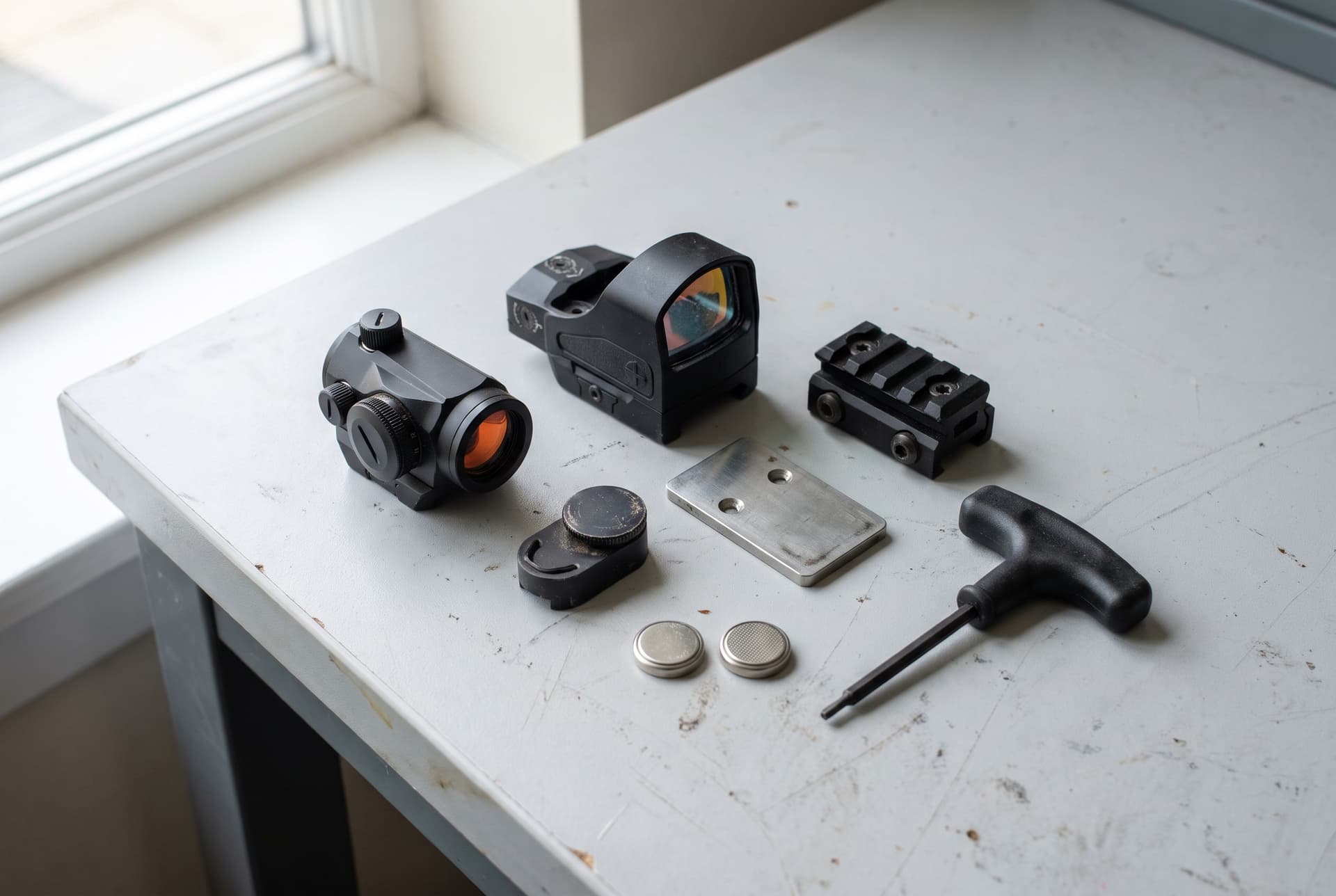
Red Dot Sights Explained: How They Work, Types, Footprints and Zeroing
A red dot sight projects a small illuminated aiming point onto a coated lens in front of your eye. You look through the glass, put the dot on the target and the dot stays where it is pointing no matter where your head sits behind the sight, within reason. That is the whole trick, and it is why a red dot is faster than lining up a front and rear sight.
The decisions that matter are narrower than the marketing suggests: open or closed emitter, how big the dot is in MOA, which mounting footprint your slide or rail uses, and whether the sight holds zero under recoil. Get those four right and almost any reputable sight will do its job.
This guide explains the technology in plain language, sorts out the reflex, prism and enclosed emitter labels, covers the Glock-and-pistol mounting question that trips up most first-time buyers, and walks through a zeroing procedure you can follow at the range. We sell optics and mounting hardware, not firearms, so everything here is about the sight and how it attaches.
How a Red Dot Sight Works
Inside the sight body there is a small LED emitter, usually red or green, pointing at an angle onto the back face of the front lens. That lens is curved and carries a dichroic coating, a thin multi-layer film that reflects the narrow band of light the LED produces while passing almost everything else. You see the world through the glass normally, plus one bright dot floating on it.
Because the lens is a curved mirror section, roughly parabolic, and the emitter sits near its focal point, the reflected light leaves the lens in near-parallel rays. Your eye focuses those rays as if the dot were far away, out at the target rather than on the glass. That is why you can keep your focus on the target instead of shifting between a front sight and a rear notch.
The same optical geometry gives you parallax. Move your head off the optical axis and the dot shifts slightly against the target. On a quality sight at normal distances the shift is small enough to ignore for practical work, and it grows as the target gets closer or further than the distance the sight is optimised for. The practical lesson is simple: at longer ranges, take the extra half second to centre your eye behind the glass.
Nearly all of these sights are 1x, meaning no magnification and unlimited eye relief. You can mount one anywhere on a rail and shoot with both eyes open. Nothing about a red dot makes a shot more accurate on its own. It removes one alignment task, which makes you faster and more consistent under pressure or with aging eyes.
Reflex, Prism, Holographic and Enclosed Emitter
These words describe how the sight is built, not how good it is. Reflex sight is the broad term for any sight that reflects a projected reticle off a lens. Almost every small red dot on the market is a reflex sight, so "reflex vs red dot" is not really a choice between two things. It is one category described two ways.
An open reflex sight has an exposed emitter: a body shaped like a hook or a horseshoe, with one lens and an open channel between the lens and the emitter housing. An enclosed emitter or closed emitter sight wraps that path in a sealed tube with glass at both ends, so the emitter sits inside the body and the light path is protected.
A prism sight is different. It uses an etched reticle and a prism to fold the light path into a short body, is usually magnified at a fixed power, and has defined eye relief like a scope. The etched reticle still works if the battery dies. A holographic sight uses a laser diode and a recorded hologram rather than a simple reflection, which lets the reticle stay sized correctly through a magnifier and shifts the parallax behaviour. Holographic units are generally larger and hungrier on batteries.
For most buyers the real decision is open reflex versus enclosed emitter, in a size that suits the host. Everything else is a specialist choice.
Open vs Closed Emitter: The Real Trade-Off
An open emitter is lighter, usually lower, often cheaper, and gives a wide unobstructed view because there is only one piece of glass between you and the target. That is why most compact pistol sights are open. The weakness is the open channel. Rain, snow, lint from a holster, dust and brass shavings can land on the emitter or on the inside face of the lens. When that happens the dot dims, smears or disappears while the rest of the sight looks perfectly fine.
A closed emitter seals that path. In sustained rain, snow, blowing dust, or inside a concealment holster where lint collects, an enclosed sight is markedly more reliable. The costs are bulk, weight, usually a higher price, and a slightly smaller apparent window because you are looking through a tube with glass at both ends. Water on the outside of either lens still obscures the view, so a sealed sight is not immune to weather, just to the specific failure of a blocked emitter.
Pick open if the sight lives on a range gun, a rimfire, a hunting rig that stays in a case, or anywhere you can wipe the lens before use. Pick closed if the sight rides on a carry gun, a duty gun, or anything that lives outdoors in bad weather. If you run an open sight in wet conditions, get in the habit of checking the dot before you need it, and keep a microfibre cloth where you can reach it.
One more habit worth building regardless of type: learn where the dot sits relative to your irons, and keep a backup aiming option on the gun. Flip-up iron sights on a rifle, or suppressor-height irons that co-witness through a pistol optic window, mean a dead battery or a fogged lens is an inconvenience rather than the end of the day.
Dot Size in MOA and What It Covers at Distance
Dot size is given in MOA, minute of angle. One MOA is one sixtieth of a degree, which works out to roughly 1.047 inches at 100 yards, close enough to call it an inch per hundred yards. So a 2 MOA dot covers about 2 inches of target at 100 yards and about half an inch at 25 yards.
Smaller dots let you aim more precisely and obscure less of a distant target. Larger dots are easier to find quickly, especially under stress or in bright sun, and they are more forgiving when you are moving. A dot that looks crisp on a bench can look like a starburst to an astigmatic eye at high brightness, which is worth knowing before you blame the optic: turning brightness down, or trying a green emitter, often cleans the dot up.
Common practical splits: 6 MOA and up for shotguns and close work, 3 MOA to 4 MOA as a general purpose pistol and carbine size, 2 MOA where precision at distance matters more than speed. Some sights give you a dot inside a large ring, which lets you use the ring for fast close work and the dot for a careful shot.
Green emitters are often perceived as brighter than red at the same power because the human eye is more sensitive to green in daylight. That is a perception difference, not more output, and either colour works.
| Dot size | Approx. coverage at 25 yd | Approx. coverage at 50 yd | Approx. coverage at 100 yd |
|---|---|---|---|
| 2 MOA | 0.5 in | 1.0 in | 2.1 in |
| 3 MOA | 0.8 in | 1.6 in | 3.1 in |
| 3.5 MOA | 0.9 in | 1.8 in | 3.7 in |
| 4 MOA | 1.0 in | 2.1 in | 4.2 in |
| 6 MOA | 1.6 in | 3.1 in | 6.3 in |
Calculated from 1 MOA subtending 1.047 inches at 100 yards, scaled linearly. Figures rounded to one decimal place.
Mounting: Pistol Footprints, Rails and Risers
On a rifle or shotgun, mounting is usually straightforward. Most red dots either clamp to a Picatinny rail or come on a mount that does. The decision is height. A sight sitting directly on the rail puts the dot low; a riser lifts it so the dot lines up with a more upright head position, which is what most people mean by a lower third or absolute co-witness with iron sights. A QD mount, with a throw lever, lets you pull the sight off and put it back without hand tools, which is useful if you swap optics between hosts or need the irons clear.
Pistols are where it gets fiddly. The pattern of screw holes and recoil lugs cut into the top of a slide is called a footprint, and the names are borrowed from the optics that defined them. Common ones include the RMR pattern for full-size optics, the RMSc pattern for slim subcompact optics, and the ACRO pattern used by some enclosed sights. A sight only bolts directly to a slide cut in the matching pattern.
That is why a factory optics-ready pistol, such as a Glock MOS model, commonly ships with a set of adapter plates, though you should check what is included with yours. The plate bolts to the slide and the optic bolts to the plate, which is how one slide cut accepts several footprints. The trade-off is one more joint to come loose and a slightly higher dot. Plates that also carry rear iron sights are a tidy way to keep a backup aiming reference.
If the slide is not cut for an optic, a gunsmith has to mill it, which is work for a qualified shop rather than a home project. Some shotguns use a dedicated receiver mount instead. Before you buy any pistol optic, confirm the footprint on the slide or plate, not just the pistol model. Manufacturers change cuts between generations.
How to Zero a Red Dot Sight, Step by Step
Zeroing means adjusting the sight so the dot and the point of impact meet at a chosen distance. Work at a safe range, follow the range rules, and keep the firearm pointed downrange throughout. Here is the sequence.
First, mount it properly. Clean the mounting surface and the underside of the optic so no grit sits in the joint. Use the screws supplied with the optic, not longer ones, and tighten them in a cross pattern to the torque value in the optic's manual. Threadlocker is often specified. An optic that was never tightened correctly will drift and no amount of adjusting will fix it, so do this part carefully.
Second, get on paper close. Set a target at a short distance, 10 or 15 yards, from a stable rest. Fire a small group, three to five rounds. Do not chase single shots. Measure from the centre of the group to the point of aim.
Third, read the adjustment value. Each click of the windage or elevation turret moves impact by a stated amount, commonly 1 MOA or 0.5 MOA per click, and the value is printed on the sight or stated in the manual. Because 1 MOA is about an inch at 100 yards, a 1 MOA click moves impact about a quarter of an inch at 25 yards and about an inch at 100. Count clicks in the direction marked on the turret, which moves the point of impact, not the dot.
Fourth, move out and confirm. Repeat the group, adjust, and repeat at your chosen zero distance. Fire a final confirming group without touching the turrets. Then leave it alone, note the zero distance somewhere you will remember, and re-check it after any hard knock, any time you remove and refit the optic, and at the start of a season.
| Click value | Impact shift at 25 yd | Impact shift at 50 yd | Impact shift at 100 yd |
|---|---|---|---|
| 0.5 MOA | 0.13 in | 0.26 in | 0.52 in |
| 1 MOA | 0.26 in | 0.52 in | 1.05 in |
| 2 MOA | 0.52 in | 1.05 in | 2.09 in |
Derived from 1 MOA subtending 1.047 inches at 100 yards. Check the click value stamped on your own sight; it varies by model.
Red Dots on Bows, Shotguns and Air Rifles
A red dot works on anything you aim, and archery is a common use. Mounted on a crossbow or on a vertical bow with a suitable bracket, a 1x dot gives you one aiming point, no peep alignment and good performance in low light, which is why crossbow shooters often prefer them. Many crossbow-specific optics use multiple stacked dots calibrated to a particular bolt speed, so the lower dots correspond to longer ranges.
Two things to check before fitting a dot to archery equipment. First, the mount: bows and crossbows use their own rail and bracket systems, and a rifle ring will not simply clamp on. Second, the rules. Whether an illuminated or electronic sight is legal for hunting is set by the state wildlife agency, and the rules vary by state, by season and sometimes by weapon class. Some competition formats restrict them too. Check the current regulations for the place you will hunt or shoot before you buy.
On shotguns, a larger dot suits the job and a dedicated receiver mount is more stable than clamping to a flimsy rib rail. On air rifles and rimfires, recoil is light but spring-piston airguns produce a sharp two-way impulse that has broken optics not rated for it, so check that the sight is suited to the host before mounting.
Whatever the host, re-confirm zero after mounting. A sight that was zeroed on one platform is not zeroed on another.
What to Check Before You Buy
Work through this list in order and the choice narrows fast. Footprint or mount first: what will this physically attach to, and do you need a plate or a riser. Emitter type second: open for light and width, enclosed for weather and pocket lint. Dot size third, matched to the distances you actually shoot. Battery type and claimed runtime fourth, along with whether you can change the battery without removing the sight and losing zero, which is a genuine convenience on a pistol.
Then look at the practical details. Is there an auto-brightness mode, and can you override it. Does the sight have a shake-awake feature that sleeps and wakes with movement. How many brightness settings are there, and does the lowest one work with night vision if that matters to you. Is the housing aluminium or polymer, and does the weight suit the host.
In stock we carry open reflex sights in 2 MOA, 3 MOA, 3.5 MOA and 4 MOA, including slim RMSc-footprint units for subcompact slides, along with an enclosed emitter sight and a micro prism sight. We also stock flip-up backup iron sights, optic-height night sights and Glock MOS optic plate and sight combos, which are the parts most people realise they need about a week after the optic arrives.
One last piece of advice: budget for the mounting hardware and a spare battery at the same time as the sight. A good optic sitting on an improvised mount is a worse setup than a modest optic mounted correctly.
Red dot and reflex sights in stock
Open reflex and micro dot sights in a range of MOA sizes, for pistols, rifles and shotguns.
Mounts, plates and backup irons
The hardware that gets an optic onto the host and keeps an aiming reference if the battery quits.
Optic-height and backup iron sights
Tritium and fiber-optic sight sets, including optic-height sets that co-witness through a pistol dot.
Common questions
- What is the difference between a reflex sight and a red dot sight?
- In practice there is none. Red dot describes what you see, a small illuminated aiming point. Reflex describes how it is made, by reflecting a projected reticle off a coated lens. Almost every compact red dot is a reflex sight. The useful distinction is open emitter versus enclosed emitter, and separately prism or holographic sights, which use different optical methods.
- Is a closed emitter red dot worth the extra size?
- If the sight lives on a carry gun, a duty gun or anything used in rain, snow or dust, yes. Sealing the emitter removes the one failure that kills an open sight: debris or water blocking the light path so the dot dims or vanishes. For range use, hunting rigs kept in a case, or weight-sensitive builds, an open emitter is lighter, lower and gives a wider view.
- Can I put a red dot on a Glock?
- Only if the slide is cut for one or the pistol is an optics-ready model such as MOS, which uses adapter plates to match different optic footprints. A standard slide has to be milled by a qualified gunsmith. Confirm the footprint on your specific slide or plate before ordering an optic, because cuts vary between generations and models.
- What dot size should I choose?
- Match it to distance. One MOA covers roughly an inch at 100 yards, so a 2 MOA dot covers about two inches there and a 6 MOA dot about six. Smaller dots aim more precisely at range, larger dots are quicker to find up close. Three to four MOA is a sensible general-purpose size for pistols and carbines.
- How far should I zero a red dot?
- That depends on your platform and the distances you shoot, so pick a distance that matches your use and confirm it. Start close, around 10 to 15 yards, to get on paper, then move out and confirm with a group you do not adjust afterwards. Write down which distance you zeroed at, and recheck after any hard knock or remount.
- Can I use a red dot sight on a bow or crossbow?
- Yes, with a bracket made for that bow or crossbow; a rifle ring will not fit. Crossbow optics often use stacked dots calibrated to a bolt speed. Before you buy, check whether illuminated or electronic sights are legal for your season and weapon class, because the rules vary by state and locality and change between seasons.
Sources
- Geometric definition of minute of angle: 1/60 degree; tan(1/60 deg) x 3600 in = 1.047 in at 100 yd
- Calculated from 1 MOA = 1.047 in at 100 yd, scaled linearly with distance
- CIE photopic luminosity function, which peaks near 555 nm (green) in daylight-adapted vision