Rifle Sling Mount Types: Swivels, QD Cups and Loops Explained
A rifle sling attaches through a mount, and there are only a handful of mounts in common use: a threaded swivel stud, a fixed loop or bow, a push button quick detach cup, or an adapter clamped to a rail or handguard slot. Work out which one your rifle has and the swivel choice follows almost automatically.
The quickest way to tell is to look at the two ends of the rifle. A small steel post with a hole through it, sitting under the forend or the toe of the stock, is a swivel stud. A round recess about the size of a pencil eraser, with a bevelled rim, is a QD cup. A solid steel loop welded or bolted in place is a fixed loop. Anything bolted onto a slotted handguard or a Picatinny rail is an adapter, and the adapter decides what the sling sees.
This guide covers what each mount does, how to identify it, how swivel and loop widths match sling webbing, and how to install and check a mount so it does not let go when the rifle is slung over your shoulder. Check the regulations that apply where you are before you sling a rifle anywhere but your own range.
What a Sling Mount Actually Does
A sling mount is the hard point on the rifle that the sling hangs from. It is a small part doing a disproportionate job: it carries the whole weight of the rifle, it takes shock loads every time the rifle swings against your body, and on a loop sling it takes tension from your support arm when you are building a shooting position.
Three things follow from the mount you have. First, how quickly you can take the sling off. A quick detach fitting comes off in a second with a thumb press, a threaded stud needs a screwdriver or a fiddly swivel pin. Second, how quietly the rifle carries. A loose swivel on a stud will tick against the stock when you walk, and metal hardware swinging against a bolt handle is the classic hunting giveaway. Third, whether the sling can rotate. A fixed loop holds the webbing at one angle, a rotating swivel lets the sling twist flat against your shoulder.
Mounts also decide where the sling sits. Front and rear studs give you a traditional carry sling. A single front cup near the receiver gives you a one point attachment. Side mounted cups let the rifle hang muzzle down against your chest. The hardware is cheap, but it sets the whole character of how the rifle carries.
Fixed Swivel Studs and Loop Bases
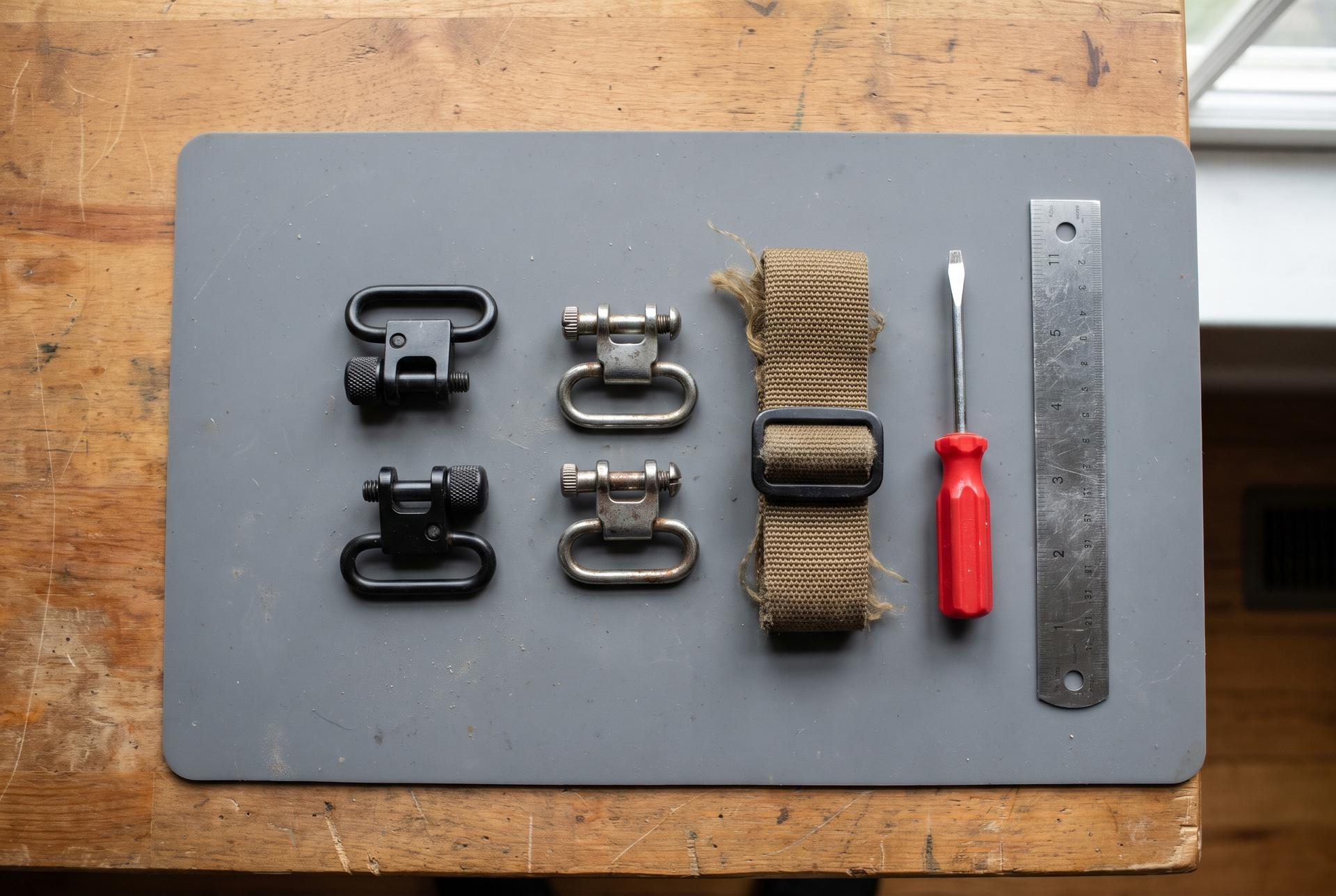
The swivel stud is the most common sling mount on hunting rifles and shotguns. It is a short threaded post with a cross hole, screwed into the forend and into the toe of the buttstock. A sling swivel fits over it: you push out the swivel's pin, slip the swivel ears over the stud, push the pin back through the stud's cross hole and screw it tight. The sling loops through the swivel's webbing bar.
Studs do a second job on bolt guns. Bipods that clamp to a stud, such as the Harris Engineering and MDT Oryx bipods the store carries, use that same post. If you run both a bipod and a sling off one forend, check how the two will share the space before you buy, because one stud will not always take both.
A fixed loop base, sometimes called a bow or a loop mount, is a solid steel loop permanently attached to the stock or receiver. It is common on military pattern rifles and on some shotguns. There is nothing to detach: you thread the sling webbing straight through the loop, or clip a snap hook onto it. Fixed loops are the strongest and simplest option, and the one you can least easily change.
Studs are strong enough for carry and for a shooting loop, but they are only as good as the wood or polymer they are threaded into. Studs that have been overtightened, or that sit in a soft synthetic stock with no reinforcement, are the usual failure point rather than the swivel itself.
Rail, Handguard and Slotted Mounting Points
Modern handguards rarely come with studs. Instead they carry attachment slots, and you bolt a sling mount into a slot where you want it. The common slot systems are M-LOK and KeyMod, and a third option is a Picatinny rail section, which takes a clamp-on sling adapter.
An M-LOK sling mount is usually a short aluminium or polymer block with a QD cup machined through it, held by one or two T-nuts that rotate behind the slot and clamp as you tighten. Picatinny adapters clamp across the rail with a crossbolt or a lever, and give you either a QD cup or a fixed loop. Either way, the adapter is what converts a slot into a mount, and the swivel you buy is chosen for the adapter's cup, not for the rifle.
Slot and rail mounting has one practical advantage worth planning around: you can put the attachment point exactly where you want it along the handguard, and move it later. Forward of the support hand for a two point carry sling, back near the receiver for a one point. Harris Engineering's M-LOK bipod in the catalog is an example of the same principle applied to a bipod, clamping into the handguard slot rather than a stud.
Check the handguard's slots before buying hardware. M-LOK and KeyMod look similar in a photograph and are not compatible. If the slot is an elongated rounded rectangle with a bevelled edge, it is M-LOK. If it is a keyhole shape, with a round opening at one end and a narrow slot running from it, it is KeyMod.
Single Point, Two Point and Three Point Attachment Compared
The number of attachment points is a separate decision from the mount type, but the two interact, because each style needs its hard points in a different place.
A single point sling attaches at one place near the rear of the receiver and loops over the head and one shoulder. The rifle hangs muzzle down in front of you and swings freely to either shoulder. It is fast to shoot from, and it is tiring to walk in, because the whole weight sits on your neck and the muzzle knocks your legs. Bungee sections help, which is why the GrovTec single point bungee sling in the catalog uses elastic shock cord and a 1.25 inch push button swivel.
A two point sling attaches at the front of the handguard or forend and at the rear of the stock. It is the standard for carry, it lets you build a loop supported shooting position, and a quick adjust slider lets you cinch it tight to the body or loosen it to shoot. The GrovTec quick slide sling in the catalog is this pattern, with wider webbing and a shoulder pad to spread the load on long walks.
A three point sling runs a loop around the body plus a rail along the rifle. It was popular before quick adjust two point slings matured. It keeps the rifle locked to the body, but it adds webbing around the ejection port and the controls, and most shooters have moved away from it.
For hunting and general field carry, a two point on front and rear studs is still hard to beat. For a rifle you work around a vehicle or a doorway with, a one point or a convertible one-to-two point makes more sense.
Matching Swivel Size and Loop Width to Your Sling
Two measurements decide whether a swivel and a sling go together: the width of the swivel's webbing loop, and the width of the sling's webbing. Hunting slings often use 1 inch webbing at the ends, and tactical two point slings are commonly 1.25 inch, though wider webbing is also sold, such as the 1.5 in webbing on the GrovTec quick slide sling in the catalog. As a general guide, narrower webbing in a wider loop tends to slide side to side, and webbing wider than the loop is difficult or impossible to thread. Measure both before ordering.
The catalog shows both: GrovTec's heavy duty push button QD swivels and black nitride swivel are 1.25 inch loop, their flush mount push button swivel set is 1 inch, and the Bravo Company QD swivel is a heavy duty 1.25 inch fitting. Check the end hardware on the sling you already own before you order.
The second measurement is the stem, covered above. Match the swivel stem to the cup, not to the brand. The third thing worth checking is strength rating. GrovTec state their heavy duty push button QD swivels are pull tested to 450 pounds, which gives you a number to compare against when a swivel lists no rating at all.
Finish matters less than people think, but it matters some. Steel swivels with phosphate, nitride or black oxide finishes resist corrosion and wear against the cup lip. Bravo Company use manganese phosphate on carbon steel, GrovTec use black nitride and black oxide on their steel swivels. In wet country, a bare or thinly plated swivel will rust in the cup and stop releasing cleanly.
| Mount type | How to recognise it | Detaches without tools | Typical sling end |
|---|---|---|---|
| Swivel stud | Small threaded post with a cross hole, in the forend and stock toe | No, the swivel pin unscrews | 1 inch webbing through a stud swivel |
| Fixed loop or bow | Solid steel loop, welded or bolted, nothing to press | No | Webbing threaded directly, or a snap hook |
| Push button QD cup | Round recess with a bevelled lip, in stock, handguard or adapter | Yes, thumb press | 1 or 1.25 inch loop on a QD swivel |
| M-LOK or KeyMod slot mount | Adapter bolted into a handguard slot, usually with a QD cup | Swivel yes, adapter no | Whatever the adapter's cup takes |
| Picatinny rail adapter | Clamps across the rail with a crossbolt or lever | Lever types yes, bolt types no | QD swivel or fixed loop |
Webbing widths of 1 inch and 1.25 inch are the two sizes listed on the sling swivels in this store's catalog. Verify your own hardware with a ruler.
Installing and Checking a Sling Mount
Clear the rifle first, every time, and keep it clear for the whole job. Work on a padded bench with the magazine out and the action open.
For a swivel stud, the stud screws into a threaded insert or directly into the stock. Snug is enough. Overtightening a stud in a wooden stock will split the wood around the insert, and in a hollow synthetic stock it will pull the insert out. If a stud turns freely without tightening, the threads in the stock are stripped and the stock needs proper repair, not more torque. For the swivel itself, screw the pin fully home so the slot in the pin head sits flush, then check that the swivel cannot be pulled off by hand.
For a QD cup, push the swivel in until you hear and feel the detent click, then pull hard on the swivel with the rifle supported. A properly seated swivel will not come out under a straight pull. If it does, check for grit or a burr in the cup, or a worn plunger. For an M-LOK or Picatinny adapter, follow the maker's torque figure if they publish one, and check that the T-nuts have rotated fully across the back of the slot rather than sitting half turned.
Then load test the whole thing before you trust it. Sling the rifle, let it take full weight, and bounce it gently. Walk a lap of the yard. Any ticking, any play in the stud, any swivel that rotates stiffly or not at all, deal with it at home. Re-check swivels and adapter screws after the first range session and then periodically, because recoil and carry both work fasteners loose.
A drop of light oil on a QD plunger keeps it releasing cleanly. Wipe the cup out after wet weather. Grit in a cup is the usual reason a swivel suddenly refuses to seat.
Picking the Mount for Your Setup
Start with the rifle, not the sling. A wood stocked bolt gun with front and rear studs wants a two point sling on stud swivels, or push button swivels if the stock has had cups fitted. A rifle with a slotted handguard and a QD cup on the receiver end plate is already set up for push button hardware, and buying stud swivels for it is wasted money.
If you want speed, go QD. The ability to strip a sling off a rifle to put it in a case, or to swap one good sling between rifles, is worth the small cost of a pair of push button swivels. If you want absolute simplicity and nothing to fail, a fixed loop or a plain stud swivel has fewer moving parts, which matters on a rifle that lives outdoors.
Buy swivels in pairs where you can, so front and rear match in finish and loop width. Keep a spare swivel in the range bag, because a swivel is small, cheap, and the thing you will drop in long grass.
One last check before ordering: if the rifle runs a bipod on the forend stud, work out where the sling will live before the bipod arrives. Mounting both on one stud is possible with the right hardware but it crowds the forend, and a sling that fouls a bipod leg is a nuisance in the field.
Push button QD sling swivels
Spring loaded swivels that lock into a standard QD cup and release with a thumb press.
Slings and sling hardware
Carry slings and swivel sets in the common 1 inch and 1.25 inch widths.
Stud and rail mounted bipods
Bipods that share the swivel stud or handguard slot your sling uses, so plan the forend together.
Common questions
- What are the main rifle sling mount types?
- Four cover almost everything. A swivel stud is a threaded post with a cross hole in the forend and stock toe. A fixed loop is a solid steel bow with nothing to detach. A push button QD cup is a round recess that a spring loaded swivel locks into. Rail and slot adapters bolt onto a Picatinny rail, M-LOK or KeyMod handguard and usually provide a QD cup.
- What is the difference between a QD sling swivel and a standard swivel?
- A standard swivel fits over a threaded stud and is held by a screw-in pin, so removing it needs a tool and a minute. A push button QD swivel has a spring loaded stem that locks into a machined cup and releases with a thumb press. QD is faster to detach and rotates freely in the cup. Standard stud swivels have fewer moving parts and suit traditional hunting stocks.
- How do I attach a sling to a rifle with swivel studs?
- Clear the rifle first. Unscrew the swivel's pin, open the swivel ears, fit them either side of the stud, push the pin through the stud's cross hole and tighten it until the head sits flush. Repeat at the other stud, then thread the sling webbing through each swivel bar and adjust. Hang full weight on it and check nothing moves before you carry it.
- Are all QD sling swivels the same size?
- Loop width also varies, commonly 1 inch or 1.25 inch, and that has to match your sling webbing. Measure the cup and the sling before ordering.
- Can I add a QD cup to a rifle that does not have one?
- Usually yes. Handguards with M-LOK, KeyMod or Picatinny sections take a bolt-on adapter with a cup built in. Hollow synthetic buttstocks can take a push button base designed for thin walled stocks, like the GrovTec hollow stock base. Stocks with no slot, rail or hollow section are harder and may need gunsmith work rather than a bolt-on part.
- Should I run a single point or a two point sling?
- Two point for carrying, hunting and any shooting position where you want sling tension. It spreads weight across the body and keeps the muzzle controlled. Single point for working close around vehicles and doorways, where you want to swap shoulders instantly. Single points are tiring on long walks because the rifle hangs muzzle down off your neck, which is why many use bungee sections.