Pistol Holster Types: How Each Carry Style Works
Holster types are really just carry positions. Where the holster sits on your body decides how comfortable it is, how well it hides under your clothes, and how fast and how naturally you can reach it. Everything else - leather or Kydex, paddle or belt loop, thumb break or locking lever - is detail built on top of that one decision.
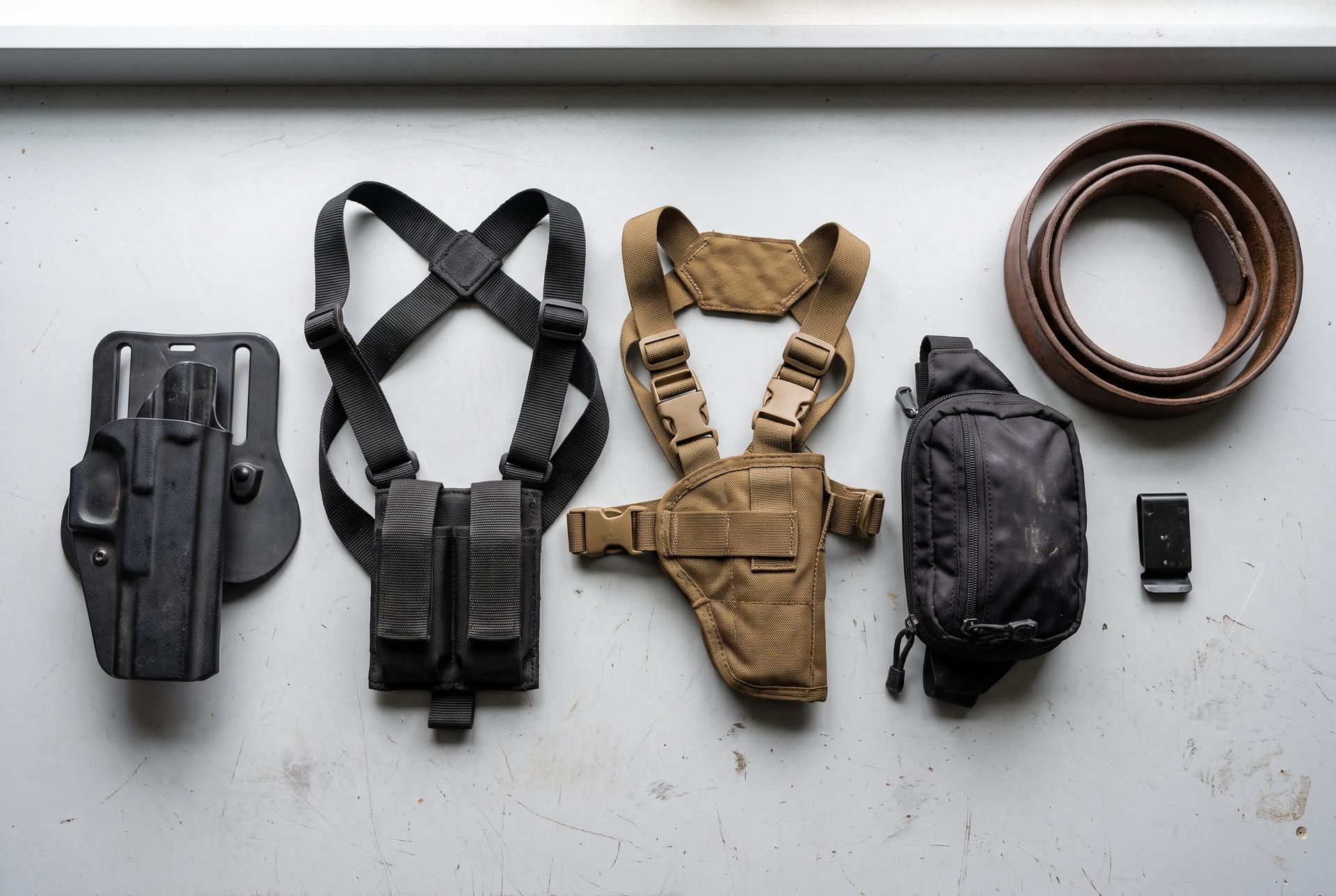
The main families are belt holsters worn inside or outside the waistband, minimal belt clips that attach to the pistol itself, pocket and ankle holsters, shoulder rigs, chest rigs and off-body carry such as a fanny pack. Each solves a different problem. A chest holster that is excellent under a pack strap is a poor choice under an office shirt, and the appendix holster that disappears under a t-shirt is miserable to wear while seated in a tree stand all morning.
This guide walks through each type, what it is good at, what it costs you, and the checks worth making before you buy. Carry laws vary by state and locality, including where and how you may carry and whether off-body carry is treated differently, so check your local rules before you commit to a method.
How holsters are categorized: position, mount and retention
Three things describe any holster. The first is carry position: waistband, pocket, ankle, shoulder, chest or off-body. The second is how it mounts: belt loops, a paddle, clips, a harness or a bag. The third is retention, meaning how hard the pistol is to pull out and what has to be defeated first.
Position is the decision you should make first, because it is the one your clothing and daily routine actually constrain. A desk worker in a tucked shirt, a hiker under a pack and a rancher in a truck all have different answers, and none of them is wrong.
Mounting method is about speed of putting the rig on and taking it off. Belt loops thread through the belt and are the most stable, but you have to undo your belt to remove the holster. A paddle holster has a flat panel that slides inside the waistband and hooks behind the belt, so the whole holster comes on and off in seconds. Clips sit somewhere between the two.
Retention is usually described in levels. Passive or friction retention relies on the fit of the shell and often an adjustable tension screw. Added retention devices include a thumb break strap, a rotating hood, or a locking lever that releases with the thumb or trigger finger. More retention means more security against a snatch or a fall, at the cost of a draw that must be practised until it is automatic.
Belt holsters: inside and outside the waistband
Belt holsters are the default for a reason. The belt carries the weight on bone rather than soft tissue, the pistol stays in one known place, and the draw is a short, direct movement you can repeat identically.
An IWB holster sits inside the waistband with only the grip and a clip above the belt line. It is the strongest option for concealment under light clothing, because the body of the pistol is hidden by your trousers. The cost is comfort and waist size: most people need trousers a size up, and the pistol presses against your side all day. Carried at the appendix position, often written AIWB, the pistol rides at the front of the waistband where it is fast to reach and easy to shield with your arm, though it is less comfortable seated.
An OWB holster rides outside the trousers on the belt. It is more comfortable, faster to draw from and easier to reholster one handed, but it needs a covering garment to conceal. Pancake and belt slide designs pull the pistol tight to the body and conceal reasonably under an untucked shirt. Duty style OWB holsters ride lower and prioritise a clean draw over hiding.
Some belt holsters convert. A convertible design ships with interchangeable loops or clips so one shell can be worn inside or outside the waistband, which is a sensible way to try both positions without buying twice. The store stocks convertible Kydex and leather holsters alongside dedicated IWB and OWB models.
Whatever you choose, the belt matters as much as the holster. A dress belt collapses under the weight and lets the pistol roll outward. A stiff gun belt sized to the holster's loop or clip width keeps the rig upright and in position.
| Type | Conceals under | Comfort | Typical mount |
|---|---|---|---|
| IWB / AIWB | T-shirt or light layer | Lower, needs waist room | Single or dual clips |
| OWB pancake or belt slide | Untucked shirt or jacket | High | Belt slots or loops |
| OWB paddle | Untucked shirt or jacket | High, fastest on and off | Paddle behind belt |
| Convertible IWB/OWB | Depends on configuration | Varies | Swappable loops or clips |
General characteristics of each belt holster family. Concealment also depends on body shape, garment cut and pistol size.
Belt clips: minimal carry without a holster body
A belt clip is a metal hook that attaches to the pistol itself, usually replacing a factory part or gripping the slide or frame, so the pistol hooks over the waistband with no holster shell at all. Techna Clip models stocked here are ambidextrous and mount to specific pistols, and the Taurus PT111 G2 clip replaces the factory slide cover plate.
The appeal is bulk. Nothing sits between the pistol and your body, so the package is as thin as the gun, which is why clips are popular with slim single stack and micro pistols and with people who cannot make a holster work under their clothing.
The trade-off is important and worth saying plainly. A clip leaves the trigger guard open. Accepted safety practice is to keep the trigger guard fully covered by the carry rig, and nothing should be able to get inside the waistband near the trigger. Many people pair a clip with a pocket or bag carry rather than against the body for this reason.
Clips also give you no reholstering support. With a holster you can put the pistol away one handed into a rigid mouth. With a clip you are hooking a loose pistol back over fabric, which takes two hands and attention. Decide whether that matters for how you carry.
Pocket and ankle holsters: the deep concealment options
A pocket holster is a soft shell that covers the trigger guard and breaks up the outline of a small pistol in a trouser or jacket pocket. The outer surface is usually made to grip cloth so the holster stays in the pocket when the pistol comes out. The DeSantis Nemesis models stocked here work that way, with a slick interior and a tacky exterior.
Pocket carry works only with genuinely small pistols and only in a pocket that is cut deep and roomy enough. A front trouser pocket on loose trousers or a jacket pocket is realistic. Jeans with a shallow pocket are not. Nothing else goes in that pocket, ever: keys and coins around a trigger guard are how accidents start.
An ankle holster straps the pistol to the inside of the weak side ankle under a trouser leg. It is the quietest way to carry while seated, which is why it suits long drives, and it stays accessible when you are belted into a vehicle seat. The store stocks an ankle rig sized for mini autos such as the Ruger LCP.
The honest downsides of ankle carry are weight on one leg, a slow draw that needs you to be seated or to kneel and pull up a trouser cuff, and a need for trousers with a wide enough leg opening. Treat ankle carry as a secondary or situational method rather than a primary one.
Shoulder holsters vs chest holsters
These two get confused constantly. A shoulder holster is a harness that hangs the pistol under your weak side armpit, usually with magazine pouches under the other arm as a counterweight. A chest holster sits on the centre or upper chest on an adjustable harness, worn over or under outer layers.
Shoulder rigs carry the pistol vertically or horizontally. Vertical carry suits longer barrels and keeps the muzzle pointed down. Horizontal carry is flatter under a jacket and gives a quicker sweep to the grip, but the muzzle points behind you, which matters on a crowded range or anywhere with people at your back. Either way a shoulder rig needs a covering jacket or an open shirt to conceal, and the draw crosses your own body, so it rewards practice. The Bulldog Deluxe shoulder holster stocked here is ambidextrous nylon with an integrated double magazine pouch, sized for 2 to 4 inch barrel autos.
Chest holsters solve a different problem: a hip is unusable when you are wearing a backpack hip belt, a harness, waders or a snowmobile suit. Moving the pistol to the chest clears the belt line entirely and keeps the grip reachable while seated, kneeling or on a quad. Hunters, anglers, trappers and backcountry hikers are the usual users. The Cole-TAC Varmint Wrangler chest holsters stocked here have an adjustable chest harness and an integrated spare magazine pouch, with one configuration cut for a weapon mounted light.
Choose a shoulder rig if you want a concealed carry method under a jacket, especially when seated at a desk or in a vehicle. Choose a chest rig if you are outdoors with a pack or heavy layers and concealment is not the goal. If you are already running MOLLE webbing on a pack or chest rig, read our MOLLE guide for how to lay out the rest of that load.
Fanny pack and off-body carry: what you give up
A fanny pack holster is a purpose built waist pack with a dedicated pistol compartment, usually opened by a pull tab so the gun is reachable without digging. The Bulldog BD860 stocked here is ambidextrous, with a quick release pull tab, a water resistant nylon shell and padding behind the gun compartment.
The advantages are real. The pack hides the pistol with no reference to your clothing at all, so it works with gym shorts, cycling kit, a wetsuit top or anything else that gives a belt nothing to anchor to. It carries a spare magazine, a light and a small first aid pouch in the same place. It also removes the waist size problem that stops many people carrying IWB.
The costs are also real. Off-body carry means the pistol is in a bag rather than on your body, so you have to keep the bag on you at all times, not slung on a chair back. The draw is slower because it is a two step movement: find the tab, open the compartment, then get the grip. And a dedicated holster pack is a recognisable shape to some people, which is the opposite of the discretion you were buying.
If you go this route, wear the pack snug and high on the hip where the tab is in the same place every time, keep the gun compartment for the gun alone, and practise the opening movement unloaded until it is boring. Check local rules too: some places treat carry in a bag differently from carry on the body.
Material and retention: matching the shell to how you carry
Three shell materials dominate. Moulded polymer and thermoplastics such as Kydex and Boltaron hold a rigid shape, keep the mouth open for one handed reholstering, and give a crisp release. They are made to fit one pistol or a close family. Safariland's SafariSeven is one such nylon blend, and the Solis ALS listing specifies a temperature rating starting at -50F.
Leather is quieter against the body and breaks in to your shape. Moulded leather holds form well. Soft unmoulded leather, like the DeSantis IWB models here, is comfortable and forgiving on fit but collapses when the pistol is out, so reholstering takes two hands. Nylon is light, cheap and flexible, which is why it dominates shoulder rigs, chest harnesses and packs, and why it is usually multi-fit rather than gun specific.
Retention devices break into a few patterns. A friction holster with an adjustable tension screw is the simplest. A thumb break uses a snapped strap over the back of the slide. Lever and hood systems, such as Safariland's ALS and the Level II lever systems on several Bulldog and Rapid Force holsters stocked here, lock the pistol as it is holstered and release with a deliberate thumb or finger movement during the draw.
Pick retention honestly. If you carry concealed under a garment and your day is low contact, friction or a single release is plenty. If you are running, working around people who could reach the gun, riding a horse or an ATV, or wearing it openly, an active retention device earns its keep. Whatever level you choose, draw it a few hundred times unloaded at home so the release is part of the motion and not an extra step you think about.
Fit, draw hand and the checks to make before you buy
Most holsters are gun specific. Check the listed model, generation and barrel length, and check it again if your pistol has a red dot or a weapon light. An optic needs a cut or a raised channel at the rear of the shell. A light changes the whole shape of the shell, which is why light bearing holsters are listed separately. Several holsters stocked here are listed as optics ready or weapon light compatible, and several are not: read the listing rather than assuming.
Draw hand matters as much as the pistol. Right hand and left hand holsters are mirror images and do not swap. Ambidextrous designs do exist, usually among nylon shoulder rigs, packs, pocket holsters and belt clips, because a soft or symmetrical body can be worn either way. Most rigid moulded shells are handed, though some stocked here, such as the Mission First Tactical AIWB/OWB models, are listed as ambidextrous.
Check the mounting hardware against your belt. Clips and loops are cut for a belt width, and forcing a 1.5 inch belt through a 1.25 inch loop leaves a holster that will not sit flat. The Stealth Operator OWB clip holster stocked here, for example, is listed as fitting belts up to 1.75 inches.
Last, check the adjustments. Cant is the angle the grip tilts, and several holsters here offer an adjustable cant range, such as the Mission First Tactical models listed at 0 to 15 degrees. Ride height changes how much grip sits above the belt. Tension screws change the effort of the draw. A holster you can tune is a holster you can live with, so set it once, then leave it and build the muscle memory.
Belt holsters, inside and outside the waistband
IWB, OWB, paddle and convertible holsters that mount to a belt.
Chest, shoulder and off-body carry
Rigs for pack straps, heavy layers and clothing that gives a belt nothing to work with.
Minimal and deep concealment carry
Belt clips, pocket holsters and ankle rigs for small pistols and awkward clothing.
Common questions
- What are the main types of pistol holsters?
- The common families are inside the waistband, outside the waistband including paddle and belt slide, pocket, ankle, shoulder, chest and off-body such as a fanny pack. A belt clip is a related minimal option that mounts to the pistol itself. Each is defined by where it sits on the body, which in turn sets its comfort, concealment and draw speed.
- Shoulder holster or chest holster: which should I pick?
- Pick a shoulder holster if you want concealed carry under a jacket, particularly while seated or driving. Pick a chest holster if you are outdoors with a backpack hip belt, waders or heavy layers that block the waistband, and concealment is not the goal. Shoulder rigs need a covering garment. Chest rigs are usually worn openly and stay reachable while kneeling or riding.
- Is a fanny pack holster better than a belt clip?
- They solve different problems. A fanny pack holster works with any clothing, carries spares and padding, but is off-body and slower to draw from, so the pack must stay on you. A belt clip is as thin as the pistol and stays on your body, but it leaves the trigger guard exposed and gives no support for reholstering. Choose based on clothing and how fast you need the draw.
- What does holster retention level mean?
- Retention describes how hard the pistol is to remove. Passive or friction retention relies on the shell fit and an adjustable tension screw. Active retention adds a device: a thumb break strap, a rotating hood or a locking lever that releases during the draw. More devices mean more security against a snatch or a fall, and more practice needed before the draw is automatic.
- Do I need a special holster for a red dot or weapon light?
- Usually yes. An optic needs a cut or raised channel at the rear of the shell so the sight is not struck. A weapon light changes the whole shape of the pistol, so light bearing holsters are moulded separately and are listed that way. Check the product listing for optics ready or light compatible wording rather than assuming your existing holster will clear them.
- What kind of belt do I need for a holster?
- A stiff belt sized to the holster's loops or clips. A soft dress belt lets an outside the waistband holster roll away from the body and lets an inside the waistband holster sag. Match the width too: loops cut for 1.5 inch belts will not take a wider one, and a narrow belt in a wide loop leaves the holster loose and shifting.