 The Prep Bible.
Fire Lays: Four Ways to Build a Campfire and When to Use Each
A campfire is three things stacked in the right order: tinder that catches a spark, kindling that catches from the tinder, and fuel wood that catches from the kindling. The fire lay is simply how you arrange those pieces. Four classic lays cover almost everything you will ever need: the teepee for a fast, hot flame, the log cabin for a steady bed of coals, the lean-to for wind and rain, and the star fire for a long, low burn on little wood.
Pick the lay to match the job. If you want a quick boil and some light, build a teepee. If you want to cook over coals for an hour, build a log cabin. If the wind is pushing your matches out and the ground is wet, build a lean-to against a solid backlog. If wood is scarce or you want a fire you can tend half the night without getting up, build a star.
The rest of this guide covers how to prepare and grade your wood, how each lay goes together, how to get one going when everything is damp, and how to put it out cold before you walk away. Fire rules and seasonal bans vary by state, county and land manager, so check the current restrictions for where you are before you strike anything.
Tinder, kindling and fuel: get this right and the lay barely matters
Tinder is anything that takes a spark or a match flame and burns on its own for a few seconds. Think fine, dry, fluffy and airy: birch bark curls, dead grass, cattail fluff, cedar bark scraped into a bird's nest, fatwood shavings, char cloth, or a cotton ball worked with petroleum jelly. Tinder does not have to come from the woods. A pack of prepared tinder in a pocket is the single easiest way to make a bad night easier.
Kindling is the bridge. It runs from matchstick thickness up to pencil and thumb thickness. Collect it in grades and keep the grades in separate piles, because the moment you need the next size up you will not want to be sorting through a heap by headlamp. Dead branches still attached to a standing tree are usually drier than anything you pick off the ground.
Fuel wood is wrist thickness and up. It is what keeps the fire going once the kindling has done its work. Split wood catches far more readily than round wood, because the split faces are dry and rough. If the outside of a piece is damp, split it and use the dry heartwood.
Gather more than you think you need before you light anything. A fire that goes out while you are off looking for the next armful is the most common way a good fire fails. Collect more kindling than feels sensible, then go back for fuel.
Preparing the site
Clear a circle down to bare mineral soil, sand or gravel. Scrape away leaf litter, duff and pine needles well past the edge of where the flames will be, because fire creeps sideways through duff where you cannot see it. Look up as well: a fire under a low branch or against a dead snag is a fire that spreads.
Lay a base of dry sticks or bark on wet or snowy ground so your tinder is not sitting in moisture. On deep snow, build a platform of green logs laid side by side. Keep water, loose soil or sand within arm's reach before you light, not after.
Where an established fire ring exists, use it. New rings scar the ground, and many land managers restrict fires to designated rings. Campfire rules, permits and seasonal bans differ by state, county and agency and change with conditions, so check what applies on the day.
The teepee lay: fast flame, light and heat
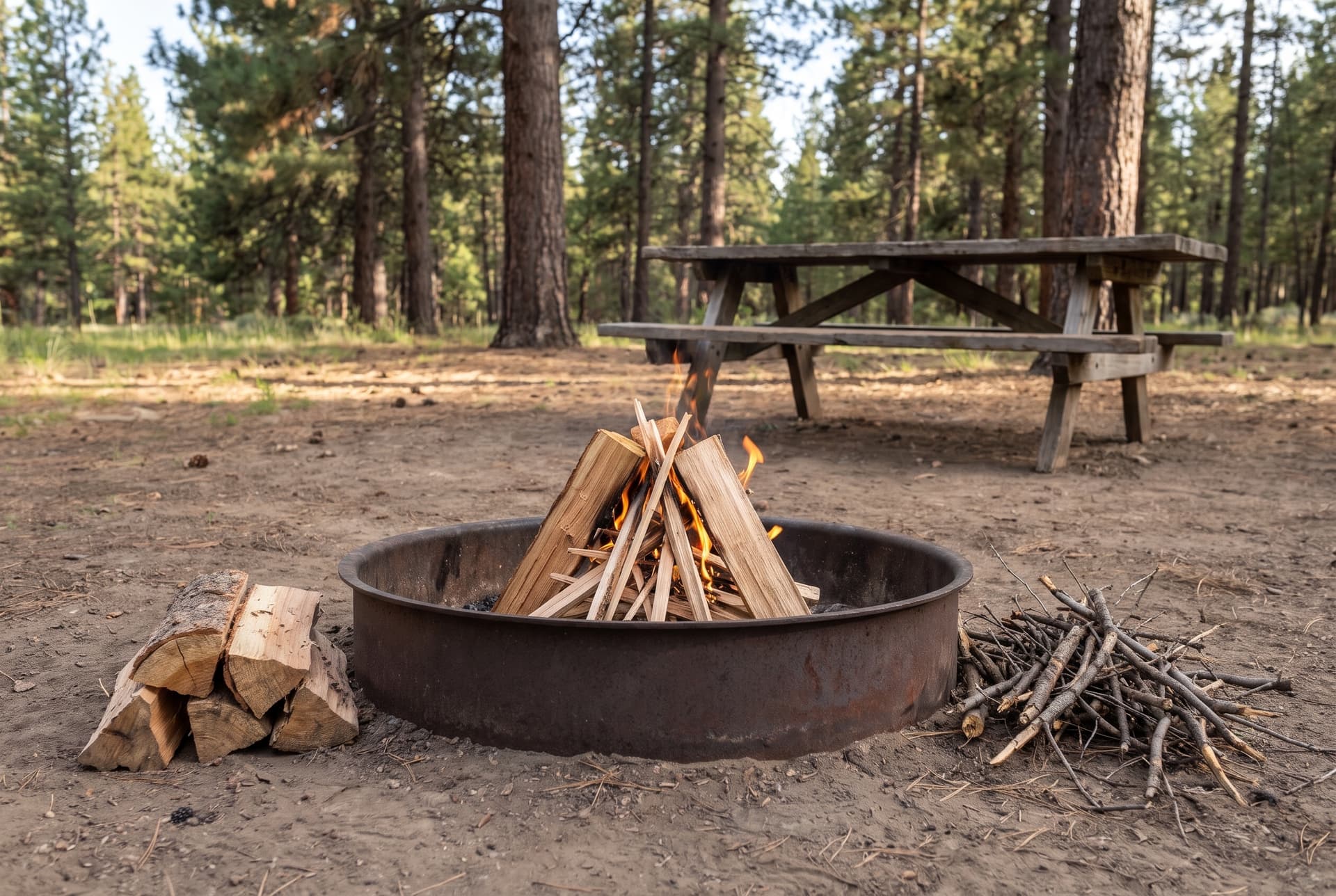
Stand your tinder bundle in the centre. Lean kindling against it in a cone, smallest first, leaving a gap on the upwind side so you can reach a match or ferro rod sparks into the middle and so air can feed in. Build the cone outward with progressively thicker sticks, then lean fuel wood around the outside.
The teepee burns hot and tall because the cone shape channels flame straight up through every piece above it. That makes it the go-to lay for boiling water quickly, drying wet gear, throwing light, and getting a fire established from marginal tinder.
The trade-off is appetite and instability. A teepee eats wood, and when the structure burns through it collapses, usually right when you are leaning over it. That is not a flaw, it is the design: let it fall inward and you have the coal bed for a different lay. Many people start with a teepee and switch to a log cabin or star once there are coals.
The log cabin lay: coals for cooking and a long sit
Lay two fuel logs parallel, a hand's width or more apart. Lay two more across their ends at right angles. Keep stacking, each layer a little smaller and set slightly inward, until you have a low square tower. Build a small teepee of tinder and kindling inside the middle, or start the teepee first and build the cabin around it.
A log cabin tends to burn down rather than up. Each layer collapses onto the one below, so you generally get a long, even burn and a deep bed of coals, though it still throws plenty of flame early on. That is what you want for cooking, for a grill grate or a pot on a tripod, and for a fire that does not need feeding every five minutes.
It is slower to get going than a teepee and it needs reasonably straight, similar-sized wood to stack cleanly. Keep the gaps between logs open. A tightly packed cabin chokes itself, and the usual fix is to lift one log and give the middle some air rather than piling on more kindling.
The lean-to lay: wind, rain and a shielded flame
Put a thick log, a rock or a packed mound of earth down as a backlog, set across the wind. Place your tinder in the sheltered pocket on the downwind side. Lean kindling at an angle from the ground up against the backlog, like a row of rafters, so the tinder sits in a protected tent underneath.
The backlog does two jobs. It blocks the wind off the flame while it is fragile, and it reflects heat back into the fire, which helps marginal fuel dry and catch. Add more kindling across the top as it takes, then build fuel wood over the structure.
This is the lay to reach for when it is blowing, when it is raining, or when your tinder is less than ideal. A variation, often called the lean-to against a backlog, uses a second log on the far side later to make a long cooking fire with a narrow slot you can straddle with a pot.
The star fire: long burn on little wood
Lay three to five long logs on the ground like the spokes of a wheel, ends touching in the centre. Build a small fire where the ends meet. As the ends burn away, push the logs inward. The fire stays small, concentrated and central.
A star fire is the lay for scarce wood, for a fire you want to keep alive overnight with minimal tending, and for any situation where a small flame is enough. It does not need the logs cut short, which matters when all you have is a saw or a small axe and not much energy left.
It gives less light and less heat than the other three, and it needs a push every so often or it dies. Control it by how far in you push the logs: in for more fire, out to damp it down. That adjustability is the real appeal.
Which lay for which job
No lay is permanent. Most real fires start as one shape and become another as the wood burns and the need changes. Light a teepee to establish flame, let it fall, then rake the coals and build a cabin over them for cooking. Build a lean-to in the rain, then add a second backlog once it is hot enough to dry its own fuel.
The table below is a quick decision aid rather than a rule. Judge by the wind, the wetness of your wood and what you actually need the fire to do.
| Lay | Best for | Burn character | Watch out for |
|---|---|---|---|
| Teepee | Fast flame, boiling, light, drying gear | Hot and tall, burns through quickly | Collapses when the cone burns through; uses wood fast |
| Log cabin | Cooking over coals, a steady fire with less tending | Burns down into an even coal bed | Slow to start; chokes if packed too tight |
| Lean-to | Wind, rain, marginal tinder | Shielded start, builds into a working fire | Needs a solid backlog set across the wind |
| Star | Scarce wood, overnight, small controlled flame | Low and long, fed by pushing logs in | Less heat and light; dies if not nudged |
General characteristics of each lay as taught in common bushcraft practice, not measured values.
Lighting a fire in wet or windy weather
Wet weather is a tinder and kindling problem, not a lay problem. Look for standing dead wood rather than ground wood, pull dead twigs from the undersides of conifers where the canopy has sheltered them, and split every piece you can to reach dry inner wood. Feather sticks, made by shaving curls along a stick with a knife and leaving them attached, turn a damp branch into usable tinder. Fatwood, the resin-saturated heartwood found in old pine stumps and knots, lights wet and is worth carrying when you find it.
Carry a backup. A ferro rod still throws sparks after it has been wet, though the tinder has to be dry enough to take them, and prepared tinder in a waterproof tin removes the hardest step on the worst night. A knife earns its place here for making feather sticks. A butane lighter is still the fastest option in good conditions; just do not make it the only option.
In wind, use the lean-to and set the backlog across the wind rather than facing it. Use an established ring where one exists; digging a fire into the ground is generally discouraged under Leave No Trace and is banned in many managed areas. Shield the strike with your body and the open side of your jacket. An established fire is less easily blown out than a young flame, but strong wind still raises the risk of spreading embers.
Keep a headlamp or a hand light on hand before dark. Sorting kindling grades and finding your tinder tin in the dark with one hand is a self-inflicted problem.
Lights for working after dark
Sorting kindling, finding your tinder and checking a fire is cold all go better with a reliable light.
Pocket knives for kindling and feather sticks
Traditional folding knives for splitting small kindling, shaving tinder and general camp cutting.
Common questions
- What is the easiest campfire lay for a beginner?
- The teepee. Stand tinder in the middle, lean kindling around it in a cone, leave a gap to get a flame in, and add bigger sticks as it catches. It is forgiving because the cone shape feeds flame upward through everything above it. Once it collapses into coals you can build a log cabin on top for cooking.
- What is the difference between a teepee fire and a log cabin fire?
- A teepee burns upward and fast, giving tall flame, bright light and quick heat, but it eats wood and falls over as it burns. A log cabin burns downward and slower, collapsing layer by layer into a deep bed of coals. Use a teepee to start and to boil water, a log cabin to cook and to sit by.
- How do I start a fire when all the wood is wet?
- Work inward. Collect standing dead wood and dead twigs from under conifer canopy rather than wood off the ground, then split everything to reach dry inner wood. Make feather sticks with a knife, and use fatwood or prepared tinder if you have it. Build a lean-to so the tinder sits sheltered, and use a ferro rod, which works when wet.
- Which fire lay is best for cooking?
- The log cabin, because it produces an even bed of coals rather than tall flame. Cook over coals, not over flames, so let it burn down first. The lean-to with a second backlog added makes a good long cooking fire too, with a narrow slot you can bridge with a grate or straddle with a pot.
- How long does a star fire last?
- As long as you keep nudging the logs inward, which is the point of it. The fire stays small and concentrated where the log ends meet, so it uses very little wood. It gives less heat and light than the other lays and will go out if left alone, so it suits a camp where somebody is nearby to push the logs in occasionally.
- How do I know a campfire is really out?
- Drown the ashes with water, stir the ash and the soil beneath it, break up charcoal chunks, and drown it again. Then check by touch. The Forest Service guidance is that if it is too hot to touch, it is too hot to leave. There should be no steam and no hissing, and common practice is to check the surrounding rocks for warm spots too.
Sources
- USDA Forest Service campfire safety guidance, "If it's too hot to touch, it's too hot to leave."
- USDA Forest Service and Smokey Bear campfire extinguishing procedure (drown, stir, drown, feel)
- Leave No Trace Center for Outdoor Ethics, Minimize Campfire Impacts principle
- Fire restrictions are set by individual land management agencies and state and local authorities; check the managing agency for current restrictions.