 The Prep Bible.
How to Choose a Gun Cleaning Kit: Pistol, Rifle, Shotgun and Universal
A cleaning kit is only worth owning if the rod, brushes and jags actually fit the bores you shoot. Start by listing the calibers and gauges in your safe, then pick a kit whose stated range covers all of them, with a rod or cable long enough for your longest barrel.
Most people end up with one of two answers. If you own a mix of handguns, rifles and a shotgun, a universal kit sized across that whole span is cheaper and tidier than three separate sets. If you shoot one bore size almost exclusively, a dedicated kit gives you the right brush in the right size without hunting through a tray of parts.
This guide covers what each piece in a kit does, how caliber and gauge sizing works, the differences between rod kits and pull-through cable kits, and what to check before you buy so you are not ordering missing parts a week later.
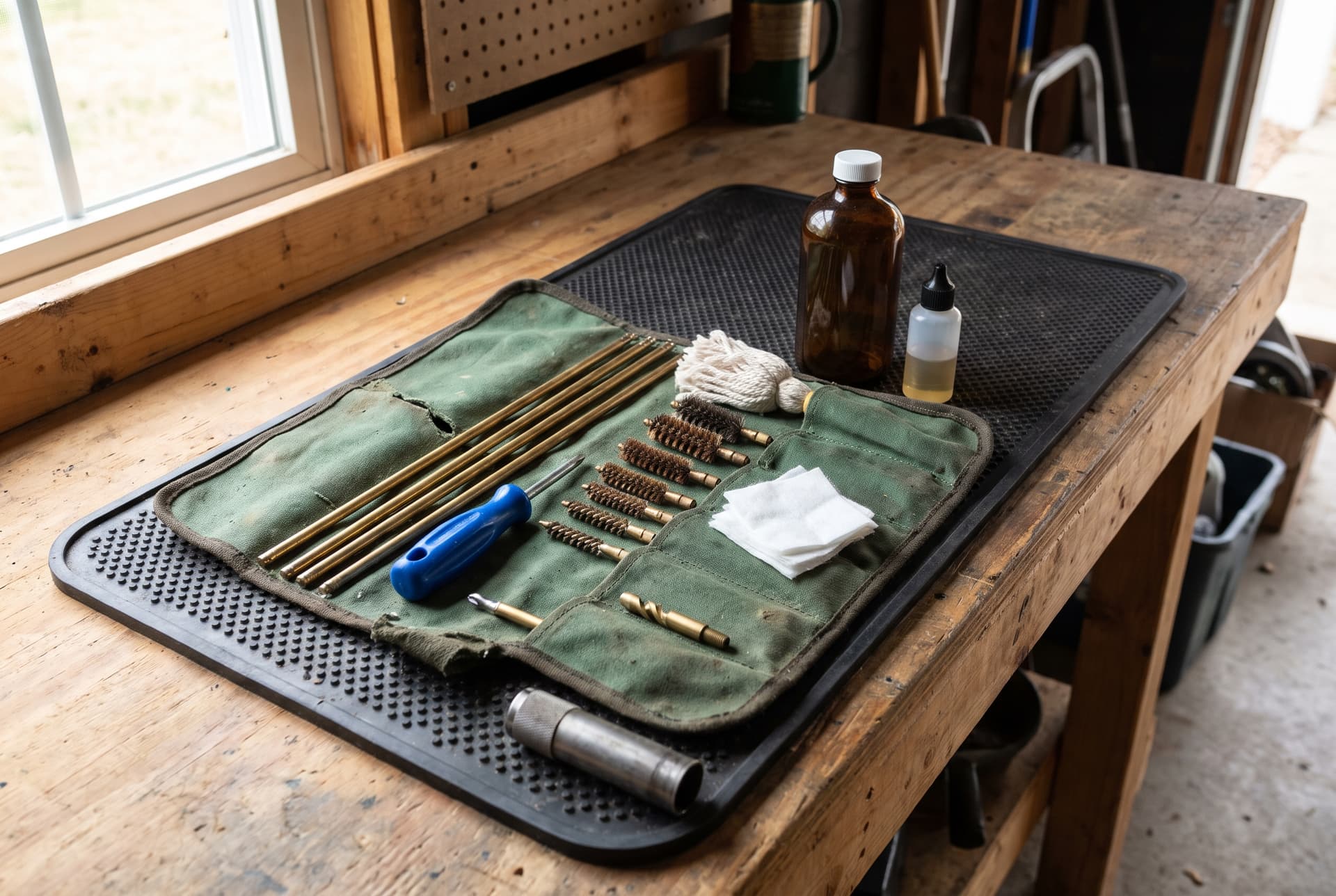
What Goes Into a Gun Cleaning Kit and What Each Piece Does
Nearly every kit is built from the same handful of parts. The cleaning rod is the shaft that carries a tool down the bore. It comes in one piece, or in sections that screw together, or as a flexible cable. The handle on the end usually swivels so the tool can follow the rifling rather than fight it.
On the business end you fit one of three things. A bore brush is a twisted wire core with bronze or nylon bristles, sized to a specific caliber or gauge, and it breaks up carbon and copper fouling. A jag is a pointed or ribbed tip that spears or grips a cleaning patch and pushes it through tight against the walls. A bore mop is a soft cotton swab for spreading solvent or soaking up what the patches left behind. A patch holder, sometimes called a slotted tip, is the older alternative to a jag and takes a patch through a slot.
The rest is support. Cleaning patches in the right size for the bore, a solvent to break down fouling, a lubricant for the moving parts, and a utility brush for scrubbing around the breech face and under the extractor. Kits are packed in a soft zip case, a hard plastic box, a steel tin or an ammo-can style container.
One piece that is not usually in the kit and should be: a cleaning mat. A long rubber-backed mat keeps parts from rolling away, protects the table from solvent, and protects the finish on the gun from the table.
Caliber and Gauge: Matching a Kit to What You Own
Brushes, jags and mops are bore-specific. A brush that is too small does nothing. A brush that is too large will not go in, or goes in and jams. So the first thing to read on any kit is the range of calibers and gauges it states, and the second is the list of brushes actually included.
Caliber is a measurement of bore diameter, in inches or millimetres. A kit listed as covering.22 to.45 is telling you the smallest and largest bores its parts suit. Watch for the grouping on the brushes: one brush usually serves a family of cartridges that share a bore size. The Otis Technology Tactical Cleaning Kit, for example, is listed as covering.17 to.50 caliber and includes six bronze bore brushes, with sizes including.22/.223,.270,.30/.308/30-06/30-30 and.38/9mm.
Shotguns are measured in gauge instead, which runs the other way: a smaller gauge number means a larger bore. The .410 is named as a caliber rather than a gauge and is the smallest of the common shotgun bores. A shotgun brush sized for 12 gauge will not serve a 20 gauge, so if you own both, check that the kit includes both or that the accessories are sold separately.
Thread size is the other half of compatibility, and it is the one people miss. Rod sections and tips screw together on a standard thread, and threads differ between smallbore rifle and pistol rods and shotgun rods. The Otis .22/.223 kit uses 8-32 threaded ends, the Shooter's Choice .30 caliber kit uses a female 8/32 thread, and the Pro-Shot shotgun patch holder uses a 5/16-27 thread to fit American standard shotgun rods. If you plan to mix brands, match the thread before you order.
| What you shoot | Bore tools you need | Kit type that fits |
|---|---|---|
| One handgun, one caliber | Brush, jag or patch holder, mop in that caliber | Dedicated pistol kit or a universal pistol kit |
| Several handguns, mixed calibers | Brushes across .22 to .45 | Universal pistol kit with multiple brushes |
| Rimfire and .223/5.56 rifles | Smallbore brushes and a long rod or cable | Dedicated .22/.223 kit |
| Mixed centerfire rifles | Brushes across the calibers you own | Universal rifle kit |
| Shotgun only | Gauge-sized brush, mop and patch holder | Shotgun kit or shotgun accessories |
| Handguns, rifles and a shotgun | Everything above, one container | Universal kit stated .22 through 12 gauge |
General guidance on matching kit contents to bore sizes. Caliber and gauge ranges quoted are those stated by the manufacturers of the kits named in this guide.
Universal Kits Versus Dedicated Caliber Kits
A universal kit is a set of parts that spans a wide range of bores, from handgun calibers up through rifle and, in the broadest kits, shotgun gauges. A dedicated kit is built around one caliber or one small family of them.
Universal wins on coverage and on storage. One box on the bench handles the safe. The Shooter's Choice universal kit states coverage from.22 through 12 gauge, and the set includes ten bronze brushes, ten cotton mops and ten brass jags with two rod diameters. The Breakthrough Clean universal kit comes with a T-handle and black oxide coated steel rods in an ammo-can container.
Universal loses on convenience at the bench. You are picking through a tray of near-identical brushes looking for the one marked .270, and the parts are generalists. A dedicated kit like the Shooter's Choice .30 caliber rifle set or the Otis .22/.223 set hands you the right tool every time, which matters more than it sounds when you clean the same rifle every week.
The honest answer for most people with a mixed safe is both, eventually. Buy the universal kit first so nothing is left uncleaned, then add a dedicated kit for the gun you shoot most. If you only own one or two guns in the same bore family, skip the universal set and buy the dedicated kit.
Pistol Cleaning Kits: Short Rods, Cables and Compact Cases
Handgun barrels are short, and the pistol kits named in this guide use short sectional rods or a flexible cable rather than a long one-piece rod. Kits built that way pack small enough to live in a range bag.
Coverage is the thing to check. A universal pistol kit states a caliber span and lists the brushes it includes. The Otis Technology universal pistol kit covers .22 to .45 and includes four caliber-specific brushes in .22, .357/.38/9mm, .40 and .45, which is the common grouping. Read that list against what you own. If you shoot something outside the stated range, the kit is the wrong one no matter how good the rest of it is.
Revolvers add a job that semi-autos do not: the chambers in the cylinder each need a brush run through them, and the face of the cylinder picks up a ring of fouling. A chamber brush or a utility brush earns its place here.
For a kit that lives in a range bag, we would take a soft case over a rigid box. The Otis universal rifle kit, for instance, is listed as a compact soft pack, and a soft case takes up the shape of the space it is in.
Rifle Kits, Including .22, .223 and AR-15 Setups
For rifles, rod length is the first spec to check. The rod or cable has to clear the muzzle with the tool still attached, so it needs to be longer than the barrel. The Otis universal rifle kit uses a 30 inch Memory-Flex cable, covers .17 through .45 and includes five caliber-specific brushes, which is a typical arrangement for a compact rifle kit.
For an AR-15 and other semi-autos that do not break open at the breech, the direction of cleaning matters. A rigid rod pushed in from the muzzle risks contact with the crown, which is the last part of the bore the bullet touches and the part you least want to wear. A pull-through cable is fed from the chamber end and drawn out the muzzle, so the tool travels the same way the bullet does. If you clean a rifle with a fixed carry handle or a receiver that blocks a straight rod run, a cable solves the geometry problem as well.
A.22/.223 kit sits in a useful spot because those bores overlap across a lot of common rifles and rimfire pistols. The Otis.22/.223 kit states coverage for.22-250,.223 Rem/5.56mm NATO, 5.7mm,.22 WMR and.22 LR, and ships with four brass rod sections and a swivel handle. Rod material is one of the things makers vary between kits, with brass, aluminium, stainless steel and coated rods all in use.
An AR also needs attention outside the bore. The bolt carrier group, the star chamber in the upper and the locking lugs collect carbon, and that is a job for a utility brush, a pick and patches rather than a bore brush. A long mat helps, since the rifle comes apart into several pieces at once.
Shotgun Kits: Gauge Tools, Chokes and Long Rods
Shotgun bores are large and smooth, so the tools are chunkier and the fouling is different. Plastic wad residue and powder fouling build up in the bore and, on a semi-auto or pump, in the gas system and action. The rods are longer to clear long barrels, and thread standards differ between shotgun rods and rifle or pistol rods, such as the 5/16-27 shotgun thread against the 8-32 used on smallbore kits.
Check the gauge, not just the word shotgun. Tools that cover a wide span exist, such as the Pro-Shot brass patch holder listed for .410 bore through 10 gauge on 5/16-27 threads, but brushes and mops are gauge-specific. If you own a 12 and a 20, you need both sizes.
Choke tubes are the part people forget. They unscrew, they collect fouling on the threads, and a seized choke is a bad day. Clean the tube and the threads, then re-fit as your firearm's manual directs. A dedicated shotgun and choke tube solvent, such as the Shooter's Choice shotgun/tube cleaner, is formulated for that job, and an aerosol cleaner like the Remington shotgun cleaner gets into the ejectors, firing pin channel and bolt recesses that a brush cannot reach.
A long shotgun comes apart into a long line of parts. A long mat, like the TekMat Mossberg Shotgun Cleaning Mat at 12 in x 36 in, gives you room to lay out the barrel, the receiver and the small parts without stacking them.
Rods Versus Pull-Through Cables
The choice between a rigid rod and a flexible cable comes down to where you clean and what you clean.
A one-piece rod is the most rigid option and has no joints to catch in the bore, which is why it is favoured at a fixed bench. Sectional rods screw together, store short and travel well, but the joints are the weak point, so keep them tight and keep them clean. Rod material matters too, and kits are offered with brass, aluminium, stainless steel and coated rods. Wiping the rod as you work is common practice, since any rod can pick up grit.
A pull-through cable is a flexible coated cable with a loop or threaded end, such as the aircraft grade Memory-Flex cable in the Otis universal rifle kit. You drop it in at the chamber, pull it through the muzzle, and the tool never gets pushed backwards against the crown. Cables pack down to nothing, which makes them the obvious choice for a range bag or a hunting pack. They are less good at scrubbing a stubborn fouled bore, because you cannot put weight behind a pull the way you can behind a push.
A bore guide is a separate accessory worth knowing about. It sits in the action and keeps the rod centred so it does not rub the chamber throat or let solvent run into the trigger group. If you clean a bolt rifle from the breech with a rigid rod, it is the single accessory that does the most good.
There is also an emergency category. Some tool kits include a compact cleaning rod for field use. That is a different job from bench cleaning, and it is not a substitute for a full kit.
Field, Range and Home Bench: Picking the Format
Think about where the kit will actually be used, because the container decides whether it gets used at all.
At home, go for the largest container with the most organisation. A hard box or ammo-can style case keeps brushes sorted by size and keeps solvent off the shelf. Pair it with a long mat and a set of hollow-ground gunsmith screwdriver bits, which is common practice for work on scope ring, sight and stock screws.
At the range, go small and soft. A compact pull-through kit, a bottle of solvent, a lubricant and a handful of patches will handle anything you need between strings. The Red Rock deluxe range bag has a rear panel that unfolds into a multipurpose mat.
In the field, the kit is for problems, not for maintenance. A cable, one brush, a few patches and a small oil bottle fit in a pocket of a pack. A wipe-down with an oiled patch before the gun goes in a case is a common habit after exposure to rain, mud or salt air.
Last check before you buy: confirm the kit covers every bore you own, confirm the rod or cable is longer than your longest barrel, and confirm the thread size if you intend to mix in accessories from another brand. Those three checks prevent almost every repeat order.
Universal cleaning kits
Sets that span handgun, rifle and shotgun bores in one container.
Caliber and gauge specific kits and tools
Dedicated kits and bore tools for one caliber family or gauge.
Solvents, mats and bench gear
The supporting kit that makes cleaning quicker and tidier.
Common questions
- What should a basic gun cleaning kit include?
- A rod or cable, a swivel handle, a bore brush sized to your caliber or gauge, a jag or patch holder, a bore mop, cleaning patches in the right size, a utility brush for the action, solvent and lubricant. Anything beyond that is convenience. A cleaning mat is not usually included and is worth adding separately.
- Is a universal gun cleaning kit good enough, or do I need separate kits?
- A universal kit is good enough if its stated caliber and gauge range covers everything you own and it includes brushes in those sizes. Kits listed as .22 through 12 gauge are built to span handguns, rifles and shotguns. Add a dedicated kit later for whichever gun you clean most often, purely for speed at the bench.
- Can I use the same cleaning kit for a pistol and a rifle?
- Yes, if the bore sizes overlap and the rod or cable is long enough for the rifle barrel. Brushes and jags are sized by bore diameter, not by the type of gun, so a .22 brush serves a rimfire pistol and a rimfire rifle. The limit is usually rod length, which is why rifle kits use longer rods or cables.
- Should I clean an AR-15 from the muzzle or the breech?
- Clean from the chamber end toward the muzzle where you can. That keeps tools from being dragged backwards across the crown, the last part of the bore the bullet touches. A pull-through cable makes this straightforward on a rifle you cannot get a straight rod into. The bolt carrier group and upper receiver need a utility brush and patches, not a bore brush.
- Will a 12 gauge cleaning kit work on a 20 gauge shotgun?
- Not for the bore tools. Brushes and mops are gauge-specific, so a 12 gauge brush will not clean a 20 gauge bore properly. Rods and some patch holders are shared across gauges when the threads match, and a few patch holders are listed as covering a wide range of gauges. If you own both, buy brushes and mops in both sizes.
- How often should I clean a firearm?
- There is no single rule. Follow the maintenance interval in your firearm's own manual first. Beyond that, a common general habit is to clean after a range session, after exposure to rain, mud or salt air, and before a gun goes into long-term storage, with a wipe-down and a light oil on bare metal in between.
Sources
- Otis Technology FG-750 Tactical Cleaning Kit product description, as listed in the store catalog
- Otis Technology FG-SRS-22 .22/.223 Rifle & Pistol Cleaning Kit product description, as listed in the store catalog
- Shooter's Choice SHF-SRK-30 .30 Cal Rifle Cleaning Kit product description, as listed in the store catalog
- Pro-Shot Products PH12 Brass Patch Holder product description, as listed in the store catalog
- Shooter's Choice SHF-SRK-UNI Universal Gun Cleaning Kit product description, as listed in the store catalog
- Otis Technology FG-610 Universal Pistol Cleaning Kit product description, as listed in the store catalog
- Otis Technology FG-210 Universal Rifle Cleaning Kit product description, as listed in the store catalog
- Otis Technology FG-SRS-22 product description, as listed in the store catalog
- TekMat TEK-R36-MOSSBERG Shotgun Cleaning Mat product description, 12 in x 36 in, as listed in the store catalog
- Red Rock Outdoor Gear 80265BLK Deluxe Range Bag product description, as listed in the store catalog
- SAAMI standard nomenclature for shotshell gauges and the .410 bore
- Breakthrough Clean Technologies BT-UAC Universal Ammo Can Cleaning Kit product description, as listed in the store catalog