 The Prep Bible.
Best Dog Breeds for Bushcraft and Camping: What Actually Works on the Trail
<parameter name="items">["If you want one answer: medium-sized working and sporting breeds with double coats and a steady head do best in the backcountry. Think Labrador and Golden Retriever, German Shorthaired Pointer, Vizsla, Australian Shepherd, Border Collie, Siberian Husky, Alaskan Malamute, German Shepherd, Bernese Mountain Dog and the Appalachian and Rocky Mountain mixes that land somewhere in the middle of all of them. They carry condition well, tolerate weather, and most of them were bred to work near a person all day rather than run off over the horizon.", "The honest caveat is that breed is the smallest part of it. A fit, well-recalled mutt beats an unconditioned purebred every time, in every weather, on every trail. Paw toughness, recall under distraction, tolerance of other campers and the ability to settle quietly at a fire are trained, not inherited. A dog that cannot be called off a deer is a liability no matter what the pedigree says.", "This guide covers what to look for in a trail dog, which breed groups suit which kind of trip, where breed stereotypes fall apart, how to build a dog up to long days, the gear that earns its weight, and how to put together a canine first aid kit alongside your own. The store does not stock dog gear, so the kit advice here is about what to buy generally and how to pack it with the rest of your load."]
What makes a good bushcraft and camping dog
Start with size. Medium-sized dogs tend to travel best. They have enough frame and coat to handle cold nights and river crossings, and enough reach to cover ground. Size also decides how hard it would be to carry the dog out if a paw split or a leg went lame, and a smaller dog is far easier to carry than a large one. That last point is the one most people never think about until it happens.
Coat matters next. A double coat sheds water, insulates when wet and buys you margin on a cold, damp night. Short, single-coated dogs chill fast once the sun drops and need a jacket and insulated bedding. Heavy, long-coated breeds handle cold well but mat badly, collect burrs and ice balls, and suffer in summer heat.
Then build and face shape. Dogs with flat faces struggle to cool themselves and have no business on long summer days. Ask your vet about feeding around exercise, especially for a large, deep-chested dog. Low-slung, long-backed dogs take a beating on blowdown and scree. Loose, big, heavy giants wear their joints out young on uneven ground.
Last, and most important, temperament. The dog has to settle. A camp dog spends far more hours lying still near a fire or a tarp than it spends moving. A dog that whines, paces, barks at every branch crack or cannot be left tied for ten minutes while you filter water will make the trip miserable for you and for every other party within earshot.
Breeds that do well in the backcountry, and why
No one breed covers every trip. Sort them by the kind of travel you actually do, then look at individual dogs inside that group.
Retrievers, both Labrador and Golden, are the default for good reason: water tolerance, a dense coat, a strong handler focus and a temperament that copes with strangers at a trailhead. They need real conditioning because many lines run heavy, and they will keep going past the point of sense, so you manage the pace, not them.
Pointing and versatile hunting breeds like the German Shorthaired Pointer, Vizsla and Weimaraner have enormous engines and excellent trail stamina, which is a gift on big days and a problem in a small camp. Short coats mean a jacket in the cold. Wirehaired versions, such as the German Wirehaired Pointer and the Griffon, trade a little speed for a coat that handles brush and weather far better.
Herding breeds, including the Australian Shepherd, Border Collie, Australian Cattle Dog and German Shepherd, give you a dog that naturally stays in orbit around its person, which makes off-lead travel easier where it is permitted. They need a job and mental work, or they invent one. Cattle dogs in particular have hard feet and travel well in rough country.
Northern breeds, the Siberian Husky, Alaskan Malamute and Samoyed, tend to suit cold weather best, though these are group tendencies and the individual dog matters more. Winter camping, sled or pulk work and genuinely low temperatures are where they shine. The trade is heat intolerance and a recall that many owners never get reliable enough to trust off lead near wildlife or roads.
Mountain and farm dogs, such as the Bernese Mountain Dog, Greater Swiss and the various livestock guardians, handle cold and carry well but cover less ground and age harder. They suit basecamp trips more than long traverses. And at the smaller end, small working terriers such as a Jack Russell, a Patterdale or a fit mixed terrier often show surprising endurance on a day hike, though you will be carrying their bedding and food and watching them closely in cold water.
| Trip type | Breed groups that fit | What to watch |
|---|---|---|
| Long summer trail days | Retrievers, pointers, Vizsla, herding breeds | Heat and paw wear, carry more water |
| Winter camping and snow travel | Husky, Malamute, Samoyed, mountain breeds | Recall, heat on milder days, ice balls in coat |
| Wet and coastal bushcraft | Labrador, wirehaired pointing breeds, Chesapeake Bay Retriever | Drying time, ear care after swims |
| Basecamp and canoe trips | Bernese and other mountain breeds, steady mixes | Joint wear on rough ground, boat manners |
| Rough, brushy, steep country | Cattle dog, Border Collie, terriers, lean mixes | Cuts and punctures, cold at night for small dogs |
General breed tendencies only. Individual fitness, coat and training matter more than group.
Breed myths: what training beats breeding
The strongest predictor of a good trail dog is not the breed, it is whether the dog comes back the first time you call it, every time, with a deer moving away through the trees. Recall is the whole ballgame. Build it on lead and on a long line, in boring places first, then in interesting ones, and pay it well every single time for the life of the dog. A dog that has learned that recall ends the fun will stop coming.
Second myth: that northern or guardian breeds are automatically cold-proof in any conditions. Coat helps enormously, but a wet, thin, tired or old dog loses heat fast, and a dog sleeping on frozen ground loses it faster. Insulation under the dog matters more than what goes over it.
Third myth: that a big dog is a safety feature. The National Park Service advises keeping pets leashed and under control around wildlife. In my view a dog that gets involved in an encounter can make it worse rather than better. A dog that chases and then comes back with something angry behind it has created the problem. In bear country the useful dog is the one that stays close, quiet and under control.
Fourth myth: that puppies can hike. Young dogs are still building joints and growth plates, and long mileage and repetitive downhill work on a growing dog is a bad trade for a short-term adventure. Ask your vet when your individual dog is ready for distance, and start with short, flat outings well before that.
The dogs that end up looking like naturals are usually the ones whose owners spent a boring year on recall, lead manners, settling on a mat, tolerating handling of feet and ears, and riding calmly in a vehicle. None of that is breed-specific.
Getting a dog fit for trail days
Condition the dog the same way you would condition yourself: gradually, with rest days, and with attention to the parts that break. For dogs those parts are pads, shoulders and the cardiovascular system.
Pads toughen with mileage on varied surfaces. Gravel, rock, packed dirt and trail all build callus. A dog that only ever walks on grass and carpet will tear up its feet on the first long day over granite or hot sand. Build that exposure over weeks, check pads after every outing and learn what your dog's normal feet look like so you notice when something is wrong.
Carry load last. If you want the dog to wear a pack, teach it to wear the empty pack first, then add a little weight, then add mileage. Consult your vet about what your individual dog should carry given its age, build and health. Water and the dog's own food are the sensible payload, split evenly left and right so the pack does not twist.
Watch heat hard. Dogs cool mainly by panting, and they are far closer to the ground than you are, on surfaces that radiate heat. Start early, rest in shade through the middle of the day, offer water often rather than once in a while, and turn around when the dog's pace drops. Heavy panting that does not settle during a rest stop, stumbling or sudden lethargy are reasons to stop, cool the dog and get help, not to push on.
Gear for a camp dog: what earns its weight
A well-fitted harness, the generic item type rather than anything sold here, beats a collar for trail work. It spreads load across the chest, gives you a handle to steady or lift the dog over obstacles, and does not choke on a hard pull. Keep a flat collar on as well for identification tags, and keep the tags current.
Leads: carry a short traffic lead for camp and trailheads, and a long line for training and controlled freedom where off-lead is not allowed. Avoid retractable leads in the woods. They tangle, they cut hands, and they teach the dog that pulling makes the line longer.
A dog pack suits a conditioned adult dog on moderate ground. Look for a panel that does not interfere with shoulder movement, a chest plate that sits off the throat, compression so the load does not swing, and a handle on top. Load it light and symmetrical. Take the pack off at camp and at every long rest.
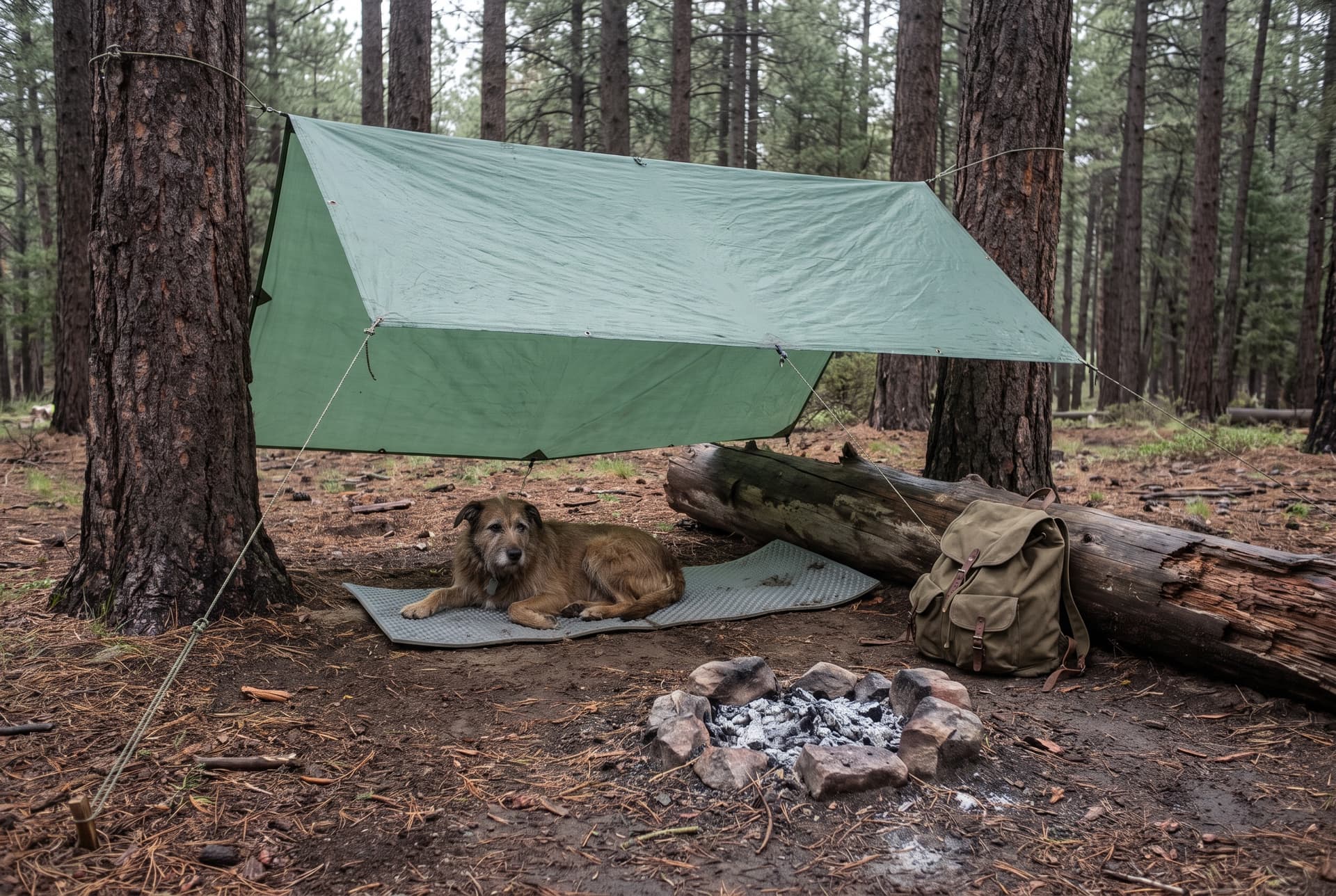
An insulated sleeping pad for the dog matters more than a coat. Ground conduction is what chills a sleeping dog. A closed-cell foam offcut, a packable dog bed or a spare pad works. In the shelter, give the dog a defined spot and train it to use that spot, which keeps your own insulation dry and keeps the dog from circling all night.
Water and bowl: a collapsible bowl weighs almost nothing. Plan on carrying water for the dog as well as yourself, and treat the dog's water the same way you treat your own where the source is questionable. A dog that drinks out of every stagnant pool will eventually find something unpleasant.
Visibility and light: a reflective harness or collar, plus a small clip-on light, makes a dark camp much easier to manage. If you hunt or travel during a firearm season, many people put a blaze orange vest on the dog, and rules for hunters and dogs differ from place to place, so check your state wildlife agency before the season.
Paw protection: boots are for specific problems like sharp ice, hot sand, snowballing between the toes or a pad injury that needs covering. Most dogs do not need them day to day. If you carry them, carry one spare, because boots get lost.
First aid for a dog in the field
Build the dog's first aid supplies into your own kit rather than carrying a separate bag. Most of what you need is the same gear, with a few additions sized for a dog. The important part is training: take a pet first aid course from a recognised provider, and talk to your own vet about what to carry for your dog, especially anything that goes in the mouth.
Do not give a dog human medication without veterinary direction. The ASPCA Animal Poison Control Center (https://www.aspca.org/pet-care/animal-poison-control) lists common human medications that are dangerous to pets. Any dosing decision belongs to a vet who knows the animal, and before any long trip it is worth asking your vet what they want you to carry and what they want you to do before calling.
What a dog adds to a kit: a roll of self-adhesive bandage that sticks to itself rather than to fur, non-stick pads for a torn pad or a cut, blunt-tipped scissors, tweezers or a tick tool, saline for flushing eyes and wounds, a clean cloth or gauze for pressure on bleeding, A frightened dog in pain may bite the person helping it, so ask your vet or a pet first aid instructor how to restrain an injured dog safely.
Before the trip, write down your vet's number, the nearest emergency vet to the trailhead and an animal poison control line, and keep that on paper where it does not depend on a phone battery. Know the dog's normal: resting breathing, gum colour, energy level. You cannot spot a change unless you know the baseline.
Keep the kit dry and check it twice a year, replacing anything that has expired or been used. Ticks are present across much of the US, so tick removal and a thorough check after every trip is routine, and a vet is the right person to ask about parasite prevention for the places you travel.
Camp etiquette, wildlife and the rules
Rules about dogs on public land vary a great deal. The National Park Service pets page (https://www.nps.gov/subjects/pets/index.htm) explains that many national parks restrict dogs to developed areas and keep them off most trails. Rules on other public land differ by agency and by unit. Leash requirements, seasonal closures around wildlife and wilderness-specific rules all differ by unit. Check the managing agency for the specific place you are going before you go, every time.
Pack out what the dog produces, the same as you pack out your own waste, or bury it to the same standard the land manager requires. A bagged pile left beside the trail to collect on the way back is the thing that gets dogs banned from trails.
Control around other people is non-negotiable. Not everyone likes dogs, some people are afraid of them, and stock animals and other dogs on lead deserve space. Step off the trail, put the dog on the downhill side of a pack string, and call the dog in before it reaches anyone.
Around wildlife, keep the dog close and quiet. Chasing deer, elk, moose or bears puts the dog, the animal and you at risk, and there may be rules against it where you are, so check with the land manager and the state wildlife agency. In snake country, teach avoidance and keep the dog on lead in rocky, warm terrain. Around a fire, set a mat well back from the ring and enforce it, because a dog that walks over coals or tips a pot of boiling water is a trip-ending injury.
Last, make the dog easy to find. Tags with a current phone number, a microchip registered to an address that still exists, and a recent photograph on your phone. A lost dog in the backcountry is the worst night you will have out there, and those three things give you the best chance of getting the dog back.
Field gear for trips with a dog
Packs and cases from the catalog that handle the gear you carry alongside a dog's kit.
Water and boat gear
If your trips run to canoe camping and shorelines, these are the marine items currently in stock.
Common questions
- What is the best dog breed for camping?
- There is no single answer, but medium-sized working and sporting breeds with double coats do best. Labradors, Golden Retrievers, German Shorthaired Pointers, Australian Shepherds, Border Collies and German Shepherds all suit long days and camp life. For winter trips, northern breeds like the Siberian Husky and Malamute are stronger. Fitness, recall and a dog that settles quietly matter more than the breed name.
- Are mixed breed dogs good hiking dogs?
- Yes, often better. A fit, medium-sized mixed-breed dog with a weather-tolerant coat, hard feet and reliable recall travels well, and conditioning matters more than pedigree. Look at the individual dog: build, coat, face shape, energy level and temperament around strangers. If you are adopting, ask the shelter or rescue about the dog's behaviour on walks and around other animals.
- How many miles can a dog hike in a day?
- It depends entirely on the individual dog, its age, its conditioning and the terrain, so there is no general number worth quoting. Build mileage gradually over weeks, watch for a dropping pace, heavy panting that does not settle at rest stops, or reluctance to move, and turn around at the first sign. Ask your vet about distance for your specific dog, especially if it is young or senior.
- Should my dog carry its own pack?
- A conditioned adult dog can carry a light, balanced load, usually its own food and some water. Start with the empty pack, add weight slowly, and keep it symmetrical so it does not twist. Take it off at camp and long rests. Ask your vet what your dog should carry given its age, build and joint health. Puppies and dogs still growing should not carry load.
- What should go in a dog first aid kit?
- Self-adhesive bandage that sticks to itself rather than fur, non-stick wound pads, blunt-tipped scissors, tweezers or a tick tool, saline for flushing, gauze for pressure on bleeding, and gauze for pressure on bleeding. Ask your vet or a pet first aid instructor how to restrain an injured dog safely. Add your vet's number, the nearest emergency vet and a poison control line on paper. Take a pet first aid course and ask your vet before carrying any medication.
- Can I take my dog on any trail?
- No. Rules vary widely by agency and by specific unit. Many national parks restrict dogs to developed areas and keep them off most trails, while national forests and many state and local lands are more permissive. Leash rules, seasonal wildlife closures and wilderness regulations all differ. Check the managing agency for the exact place you are heading before each trip.